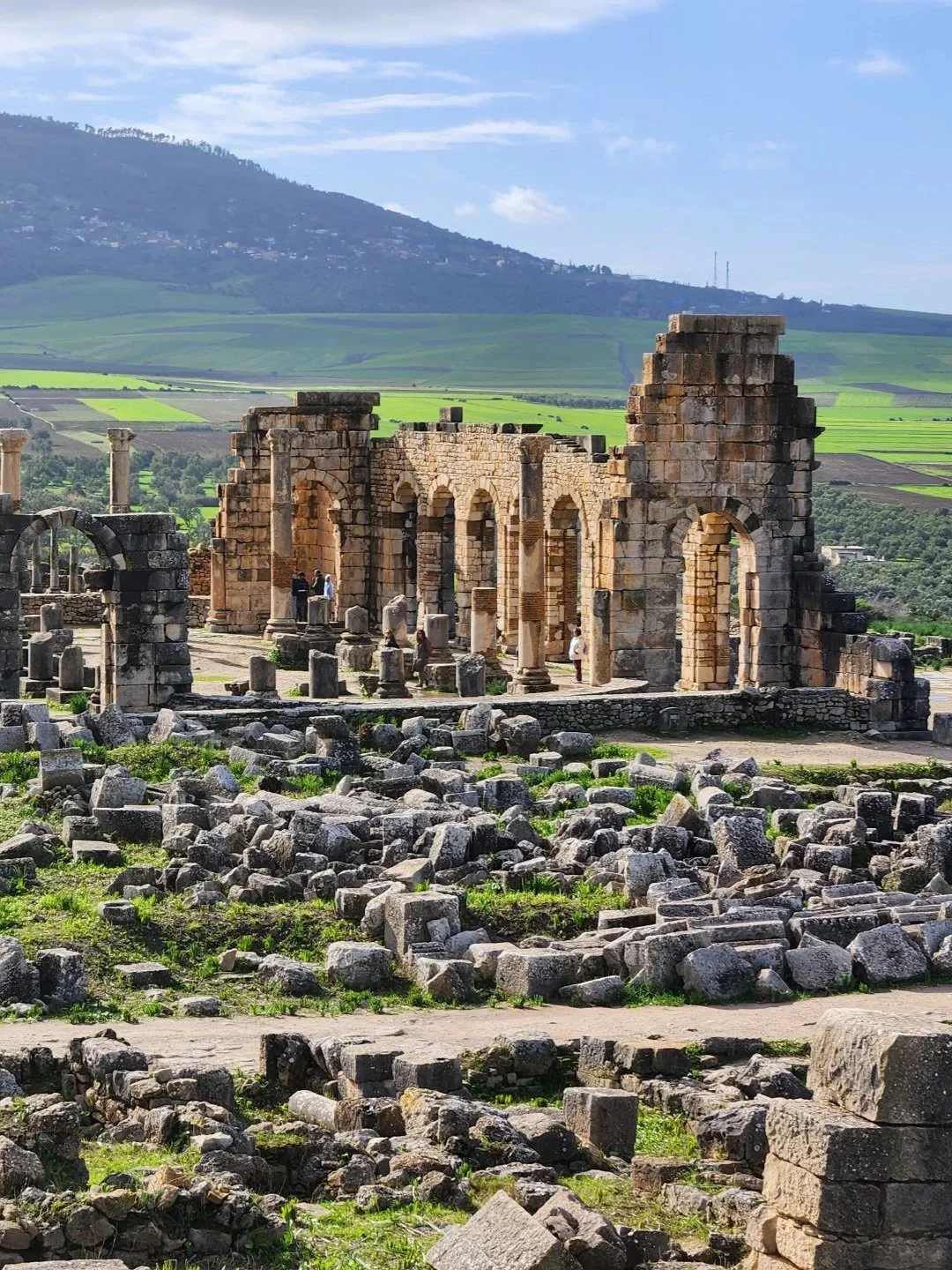
Morocco III: Volubilis
Oh, those Romans! They really got around the Mediterranean in ancient times. That included northern Morocco’s city of Volubilis (population 20,000). The Romans arrived in 44 CE and annexed the city for their Empire until they deserted it in about 285 CE.
The walking path to Volubilis
Even before the Romans arrived, Volubilis was a thriving Berber (more correctly known as Amazigh) settlement. Throughout northwest Africa, Amazigh people have a rich, proud history spanning centuries and lasting through to current times. At one point, Volubilis served as the capital city of the Kingdom of Mauritania under King Juba II, an Amazigh man and a prince whose life straddled the epochs: 48 BCE to 23 CE. Among the accomplishments of this scholar, prolific writer, and royal person was his marriage to the daughter of the Egyptian queen, Cleopatra.
Panorama of Volubilis, green plains beyond
After the Romans departed, Volubilis was inhabited by Christians, Jews, and Greeks before becoming an Islamic settlement in 788 when Idriss I (credited as the founding father of Morocco) lived there. But when the city of Fes took the seat of power from Volubilis in the 11th century, Volubilis shrank from view and was, for centuries, largely forgotten.
The Basilica
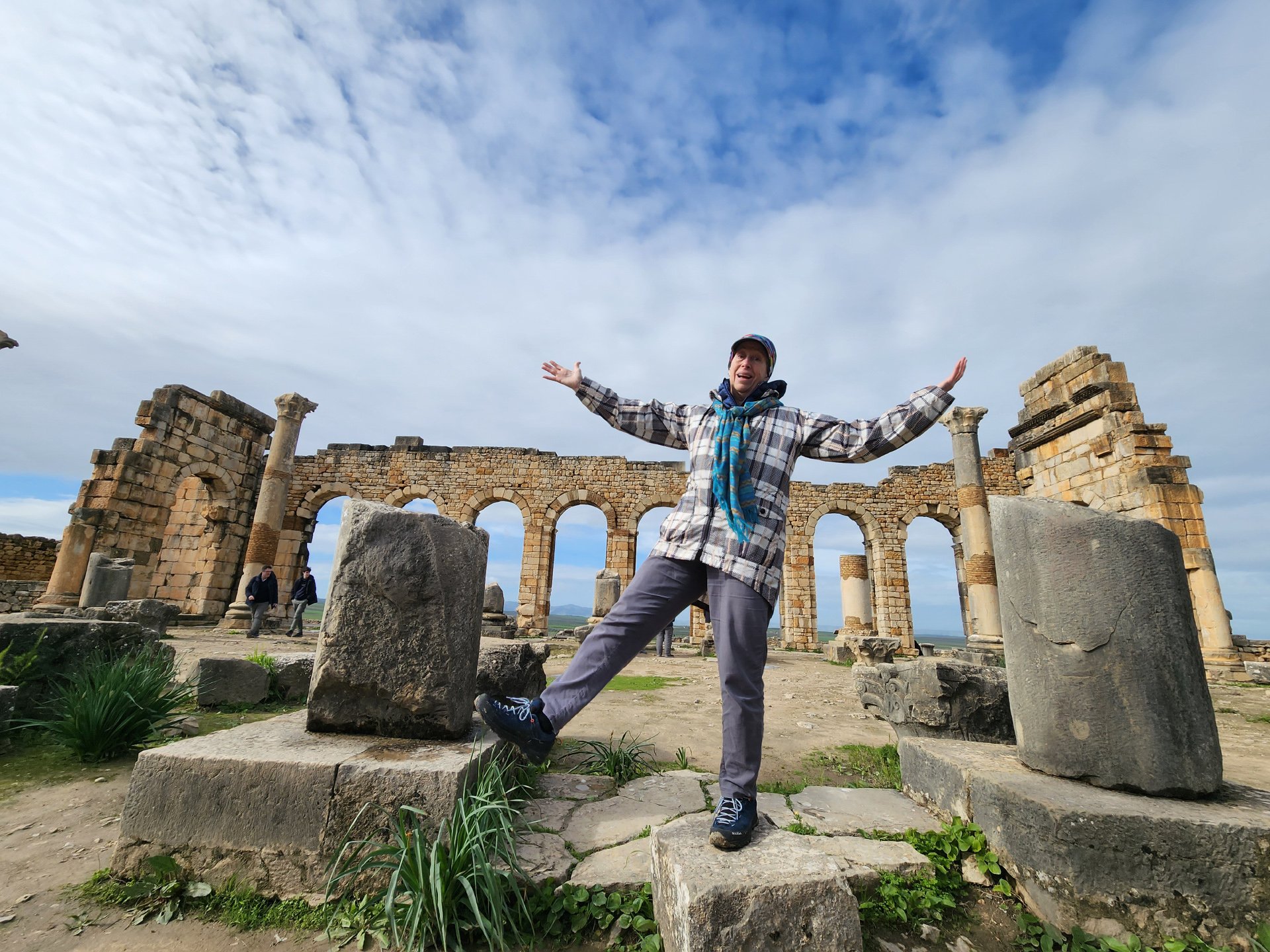
Photo fun inside the Basilica!
Our group of ten was largely oblivious to this place with the Latin name as we trundled along in our van on the Moroccan roads between the cities of Rabat and Fes in January 2026. We were crossing a beautifully green, rural stretch when Volubilis came into view on a nearby hillside. It seemed remote and at first underwhelming. As our local guide, Rashid, led us up a nothing-fancy dirt path, though, Volubilis blossomed for me into a place of real fascination.
Tourists walking along the decumanus maximus
The Triumphal Arch
What had not succumbed to neglect and abandonment was destroyed in the 1755 earthquake that leveled Lisbon. After being rediscovered in the late 19th century, Volubilis (pronounced “va-LOO-ba-lis) became the most extensive Moroccan archeological site dating back to Roman times. It is a 100-acre wander through history. (One fun fact offered by Rashid: the origin of the word “spa”! It is short for “salus per aqua,” Latin for “health through water.” Now you know.)
The entry gate at the top end of the decumanus maximus
The main boulevard, decumanus maximus, beside three arches
Made prosperous by trading opportunities and its capital status, the level of sophistication includes stunning floor mosaics in many of the aristocrat homes, an aqueduct that carried water to the fountains and baths from a half-mile away, impressively-engineered drains, and many olive presses. It is bisected by a wide boulevard called the decumanus maximus (common to Roman cities) that leads several hundred yards from the city’s main gate southwest to a 26-foot high triumphal arch. The arch, built in 217 CE, was once crowned by a sculpture of a chariot and six horses, long gone. Only this arch and the walls of the basilica were standing when excavations, beginning in 1915, brought Volubilis back to light. So far, only the city center has been excavated.
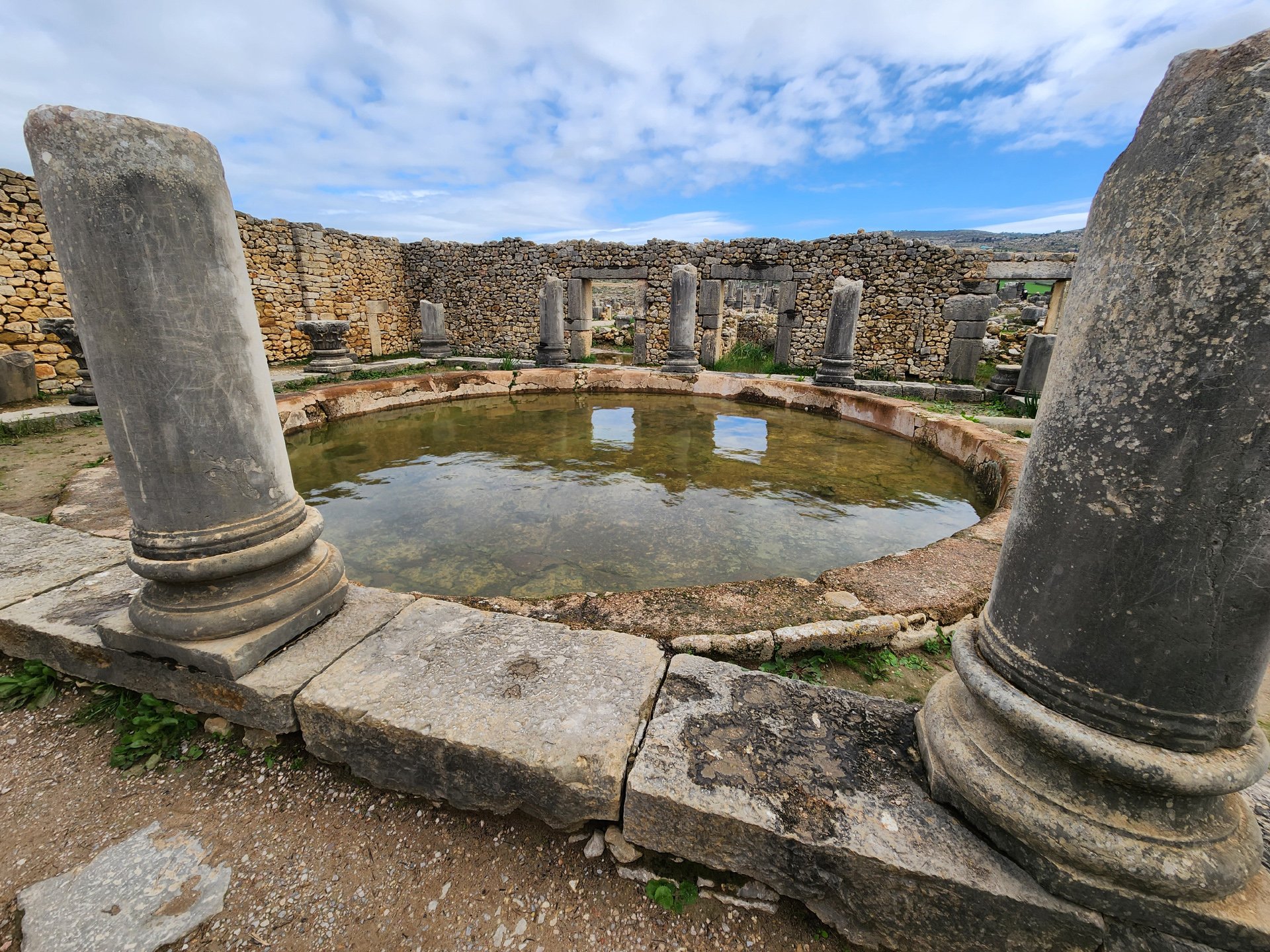
A home in the aristocratic quarter
Example of the detailed mosaics which were...everywhere!
The heart and nucleus of a Roman city (so we were told), is the forum. More than simply a market area (which is partly true), the forum also served as a public space for processions, elections, public speeches, even criminal trials. At the basilica on the eastern side of the forum, the senate would meet and higher orders of business and civic administration were conducted. Sometimes, as we take our tourist group shots, I found myself pondering, “what other feet have walked across these stones?” For thousands of years, even while it was abandoned, Volubilis (and so many places like it) has contributed to our ability to sense of the impact of mankind. It is humbling to me.
I wonder what other feet have stepped in these places?
[Our trip guide was the incomparable Ali ait Ichou, who is also an Amazigh man. Our adventure travel company was Wilderness Travel. For more about it, see https://www.wildernesstravel.com]
[Sources: https://www.britannica.com/place/Volubilis accessed March 11, 2026 and “Morocco,” Alison McGill, Sr. Editor (NYC: Penguin Random House, 2019]