Morocco IV: Fun in Fés
Our day in Fés, Morocco (pop. 1.25 million), barely scratched the surface of this ancient place. Founded in 789 CE, it has been growing organically ever since. Located in hilly terrain northwest of the Atlas Mountain range, Fés was a natural stopover early in our circumnavigation of those beautiful mountains.
Fés has served as Morocco’s imperial capital off and on some eight times, through different dynasties and reigns of power. It has certainly had its share of trouble, being rocked and ravaged by invasions and sieges and overthrows by one ruling dynasty or another in what must often have seemed a perpetual struggle for power.
But in 2026, our visit to this historical hub of manufacturing led us into a center also renowned for its sophisticated arts and crafts. We visited people making ceramics and zellige (mosaics), tanning and dyeing leather, spinning vibrant silk thread of every hue and shade, selling antiques, and weaving beautiful textiles and fabrics. Trying to peek at all these things in just one day was, well, ambitious! Properly visiting a place like Fés surely warrants more time.
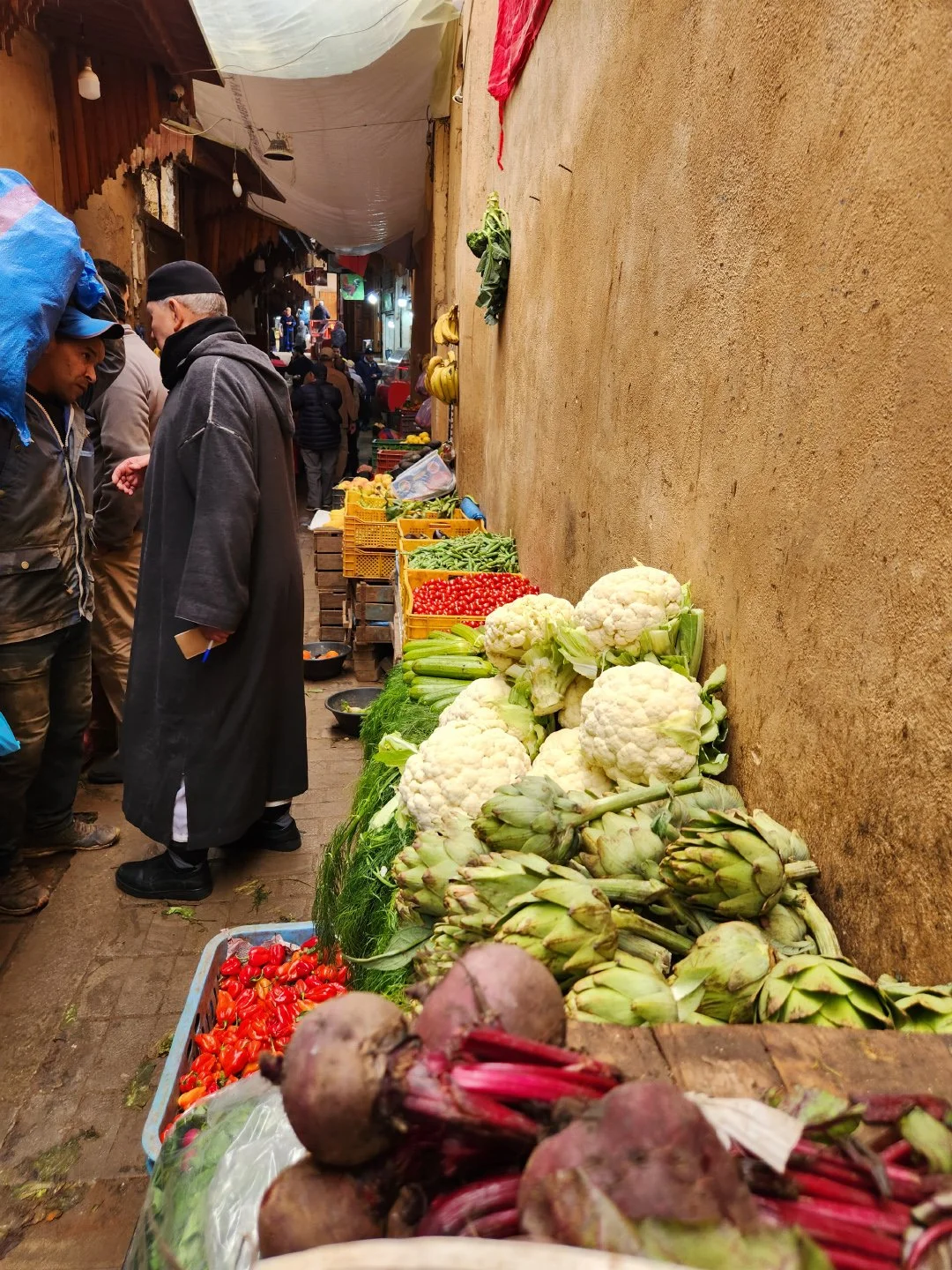
The original, oldest part of the city is called Fés el-Bali (“Old Medina”). It is an exciting and intriguing jumble of some 9,000 narrow streets which, to our eyes, more often resembled alleyways. UNESCO lists it as the world’s largest car-free urban area [Source: Google.com]. The streets wind through the different medinas (quarters) such that not even tiny cars could get through. In fact, one of the biggest challenges for our group of just 10 people (plus guides) was not to lose anyone in the crowd and crush.
Olives are a Big Deal and there are lots of them in Morocco!
One of the most famous sites (and sights) in Fés el-Bali is the Tanner’s Quarter. As we walked into one of the oldest, the Chouara Tannery, we were handed sprigs of fresh mint to hold up to our noses against the stink. Our view was from a third-floor vista looking down upon dozens of round stone and brick vats. The medieval atmosphere evokes traditions spanning thousands of years managed these days by about 50 families passing the trade from father to son.
Many of the vats held white liquids consisting of “cow urine, pigeon feces, quicklime, salt, and water”! [Source: https://en.wikipedia.org/wiki/Chouara_Tannery, accessed March 23, 2026] For several days, the brew works to clean and soften the goat, sheep, cow and (less often) camel hides. This readies them to absorb the dyes, many of which are derived from natural sources: poppies (red), indigo (blues), henna (oranges) and more. After drying in the sun, the leather is sold to artisans who produce exquisite Moroccan leather goods. (Ask me sometime about my lovely blue suede jacket, purchased at the behest of my new BIF, aka “bad influence friend,” Wendy!)
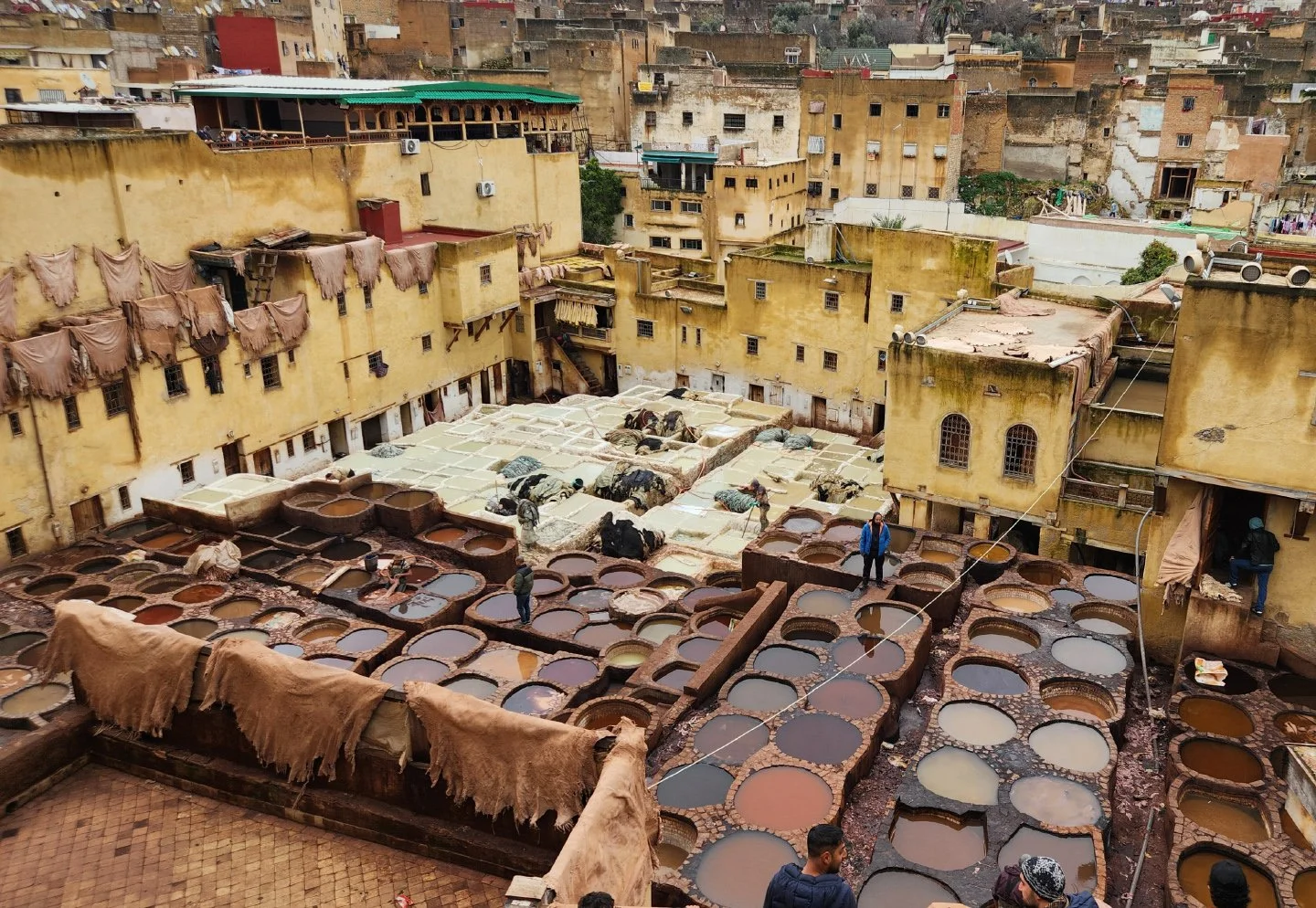
The Chouara Tannery from above.
The souks (Arabic for “marketplace”) were a feast for all the senses. We wandered past the food section (veggies, fruits, meats including a camel head) into many other fascinating areas: spices, olives (so many different ones!), slippers and shoes, henna, silks and brocades, garments such as kaftans and djellabahs, jewelry, Moroccan lights with their pinhole designs and so much more.
Our guides were masterful at maneuvering us from hither to yon. We visited Fondouk el-Nejjarine, formerly a caravanserai, or inn, where travelers could find lodging both for themselves and their animals. This one had a beautiful bricked central courtyard for the animals. Above it rose three storeys with railings of intricately carved wood. It is now a “Museum of Wooden Arts.”
The caravanserai (inn) - imagine it filled with travelers and their animals!
Our group at the center of the caravanserai floor.
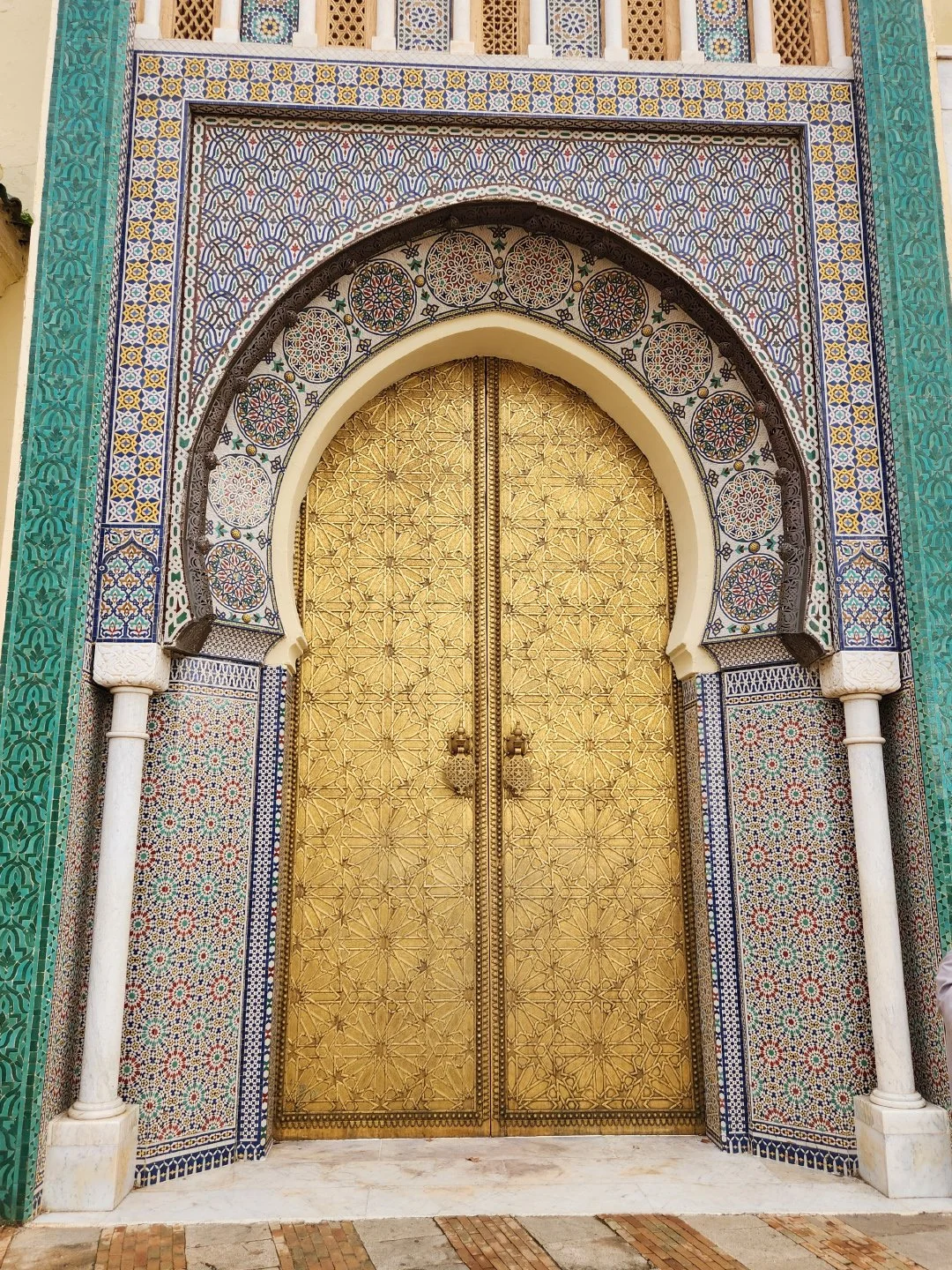
The other main section of the city is Fés el-Jedid (“New Fés” or “White Fés”). The concept of newness is relative: Fés el-Jedid was built in 1276 as a stronghold against invaders. Until 1912, when the French Protectorate came along, Fés served as Morocco’s administrative center. In the 18th century, a royal palace complex called Dar el-Makhzen was built, where Morocco’s current monarch, King Mohammed VI, stays when he’s in Fés. We stood in awe of its gateway of exquisitely engraved bronze doors for some time, just taking in the intricacy and beauty.
The gates to the Royal Palace
Intricate patterns in bronze - exquisite
It was a long but glorious day. Earlier, before losing ourselves in the old medina, we visited a ceramics co-op where we watched how Moroccan mosaic and ceramics are made, with their gorgeous shapes and elaborate, detailed designs. At the end of the day, we visited another co-op, this one with weavers who demonstrated their looms and the way they could craft amazing fabrics. In the middle of the busy day, though, came a true highlight. We stopped for lunch and were treated to a famous Fés specialty not found everywhere. Moroccan Pastilla is a savory pie filled with spiced chicken (or, more authentically, pigeon), caramelized onions, and toasted almonds wrapped in multiple layers of thin “warza” (like phyllo dough) and topped with cinnamon and powdered sugar. It is crispy! Complex! Delicious! I could go back, just for that.
[Our trip guide was the incomparable Ali ait Ichou, and our local guide (reminiscent of Al Pachino) was the incomparable “Mayor” of Fés, Rachid. Our adventure travel company was Wilderness Travel. For more about it, see https://www.wildernesstravel.com]