Morocco I: Chefchaouen
Seventeen days is too little time to make a person expert about a place, but it’s more than enough to have made me fall in love with this northwestern corner of continental Africa. That lyrical name — Morocco! — piqued my curiosity for decades. The way the word rolls off your tongue...the vivid images of snow-capped mountains...the Sahara Desert...the souks...the beautiful Moroccan craftsmanship... And such exotic city names: Casablanca, Marrakech, Rabat, Fes. It was entrancing from start to finish.
Our first glimpse of the “Blue City”
What an opportunity it was to go there and encounter a superlative guide, itinerary, and group of ten fellow travelers. Our initial plans took several of us north from Casablanca for three days to the “blue city” of Chefchaouen, pop. 46,168 (in 2024). After returning to Casablanca to meet up with our main group, we traveled for ten days by minibus, 4x4 Landcruisers, and even camels (!) as we circumnavigated the Atlas Mountain range, ending in Marrakech. As they say in Morocco: “Yela!” Let’s go!
When researching this trip, I had never heard of Chefchaouen, but given my love for words, the place-name alone intrigued me. It has as many vowels as my name! Our five hour drive carried us through beautiful agricultural areas on the flat terrain near the Atlantic coast, then uphill into the Rif mountain range to the small city founded in 1471.
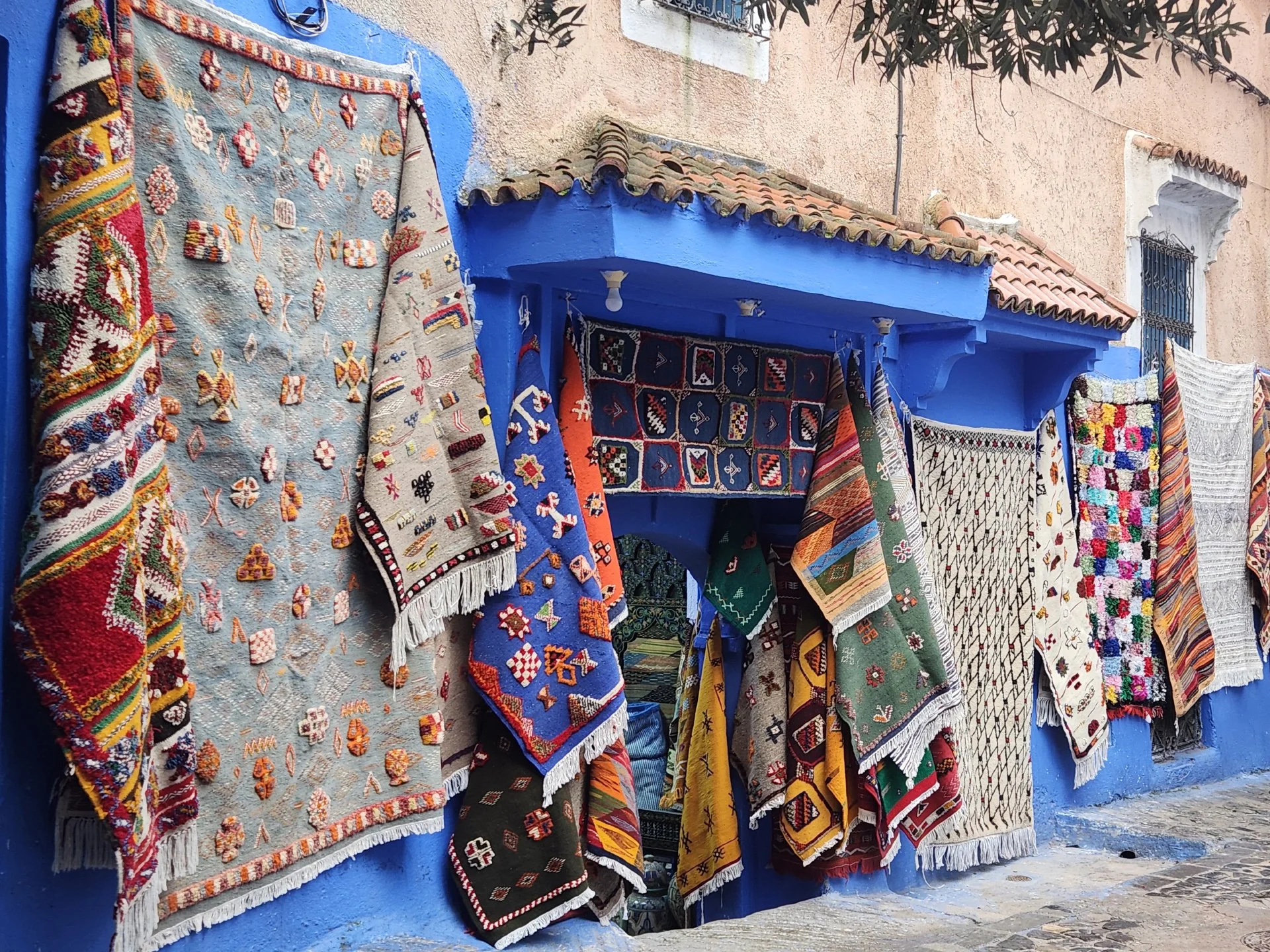
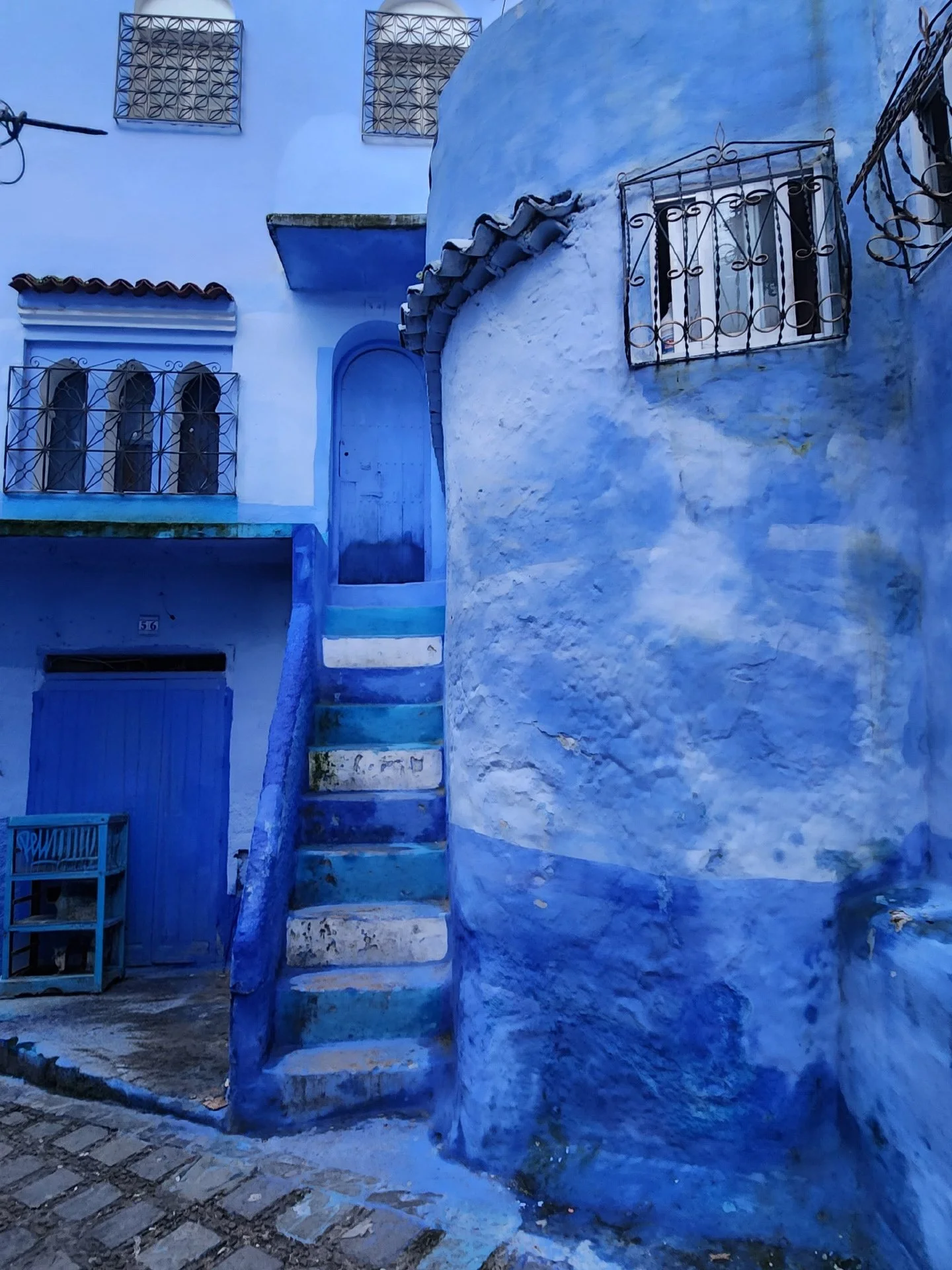
Our guide knew where to make a quick stop for some Moroccan wine at the outskirts of this dry town. (There are 14 wineries in Morocco offering excellent wines, despite Islamic prohibitions regarding alcohol.) On our way into what felt for all the world like a speakeasy, we had our first glimpse of the Blue City across the valley...and blue it is! Why? For Jewish immigrants escaping the Spanish Inquisition starting in the 1490s, it perhaps symbolized the color of the sky and protection. Or maybe to ward off mosquitoes. Or maybe because town leaders a few decades ago recognized a unique draw for tourists. Whatever the history, the effect is remarkable.
Chefchaouen, like many old Moroccan cities, was built to fend off invaders. The imposing original citadel, known as the “kasbah,” with its high walls and ten towers (and scary jail) was built in the late 1400s. It is now a museum, with a paradoxically calm central courtyard filled with beautiful trees and gardens. The “medina” (walled city) surrounding the kasbah evolved later, with its lower walls and seven arched gates. Its ancient origins resulted in a warren of very narrow, mostly cobblestone streets, rising and falling over the mountainous terrain, twisting and turning helter-skelter. It was easy to get lost, but we never felt any alarm.
The interior gardens of the kasbah (fortress)
All medinas divide organically into smaller neighborhoods, or quarters. Each quarter includes five elements: a fountain for water, a school, a bakery, a mosque, and a “hammam.” A hammam is a traditional public steam bath which, while mysterious to westerners, is locally valued for both deep cleansing and (segregated) social gathering.
The neighborhood hammam
The neighborhood baker (keeper of all the local gossip)
At night, we returned from our adventuring to a wonderful Moroccan feature: our riad. Wealthy families traditionally built their homes (riads) designed with stout exterior walls looking inward to an interior courtyard with a fountain and gardens, open to the sky—very private, very quiet. Many riads have been converted nowadays to boutique hotels, and we were the beneficiaries of this wonderful lodging concept for much of our journey.
Our riad courtyard (modernized, with glassed ceiling!
The bathroom in our room was also very blue!
It was rainy during our days in Chefchaouen, but all the Moroccans were thrilled; the nation had endured a severe seven-year drought which seemed to be ending at last. Sadly, within days of our time there, northern Morocco, including the Chefchaouen region, was hit by epic, lingering storms. “According to the International Federation of Red Cross and Red Crescent Societies, as of [Feb. 12, 2026], these events have claimed 43 fatalities, left 23 people injured, displaced roughly 300,000 residents, and affected a total of about 2 million individuals.” [Source: https://reliefweb.int/report/morocco/] Our hearts go out to everyone affected.
[Note: Our guide was the incomparable Ali ait Ichou. Our adventure travel company was Wilderness Travel. For more about it, see https://www.wildernesstravel.com]