Morocco II: Casablanca
The name “Casablanca” is familiar nowadays, but the place actually started out as the ancient city of Anfa. When the Portuguese arrived in 1468 and blew Anfa to ruins and later built a military fortress there in 1515, they called the village that grew up around it "Casa Branca" (Portuguese for "white house). Then, in 1755, the area was leveled in a massive earthquake whose epicenter was near Lisbon. (It seems a bit like divine intervention to me.)
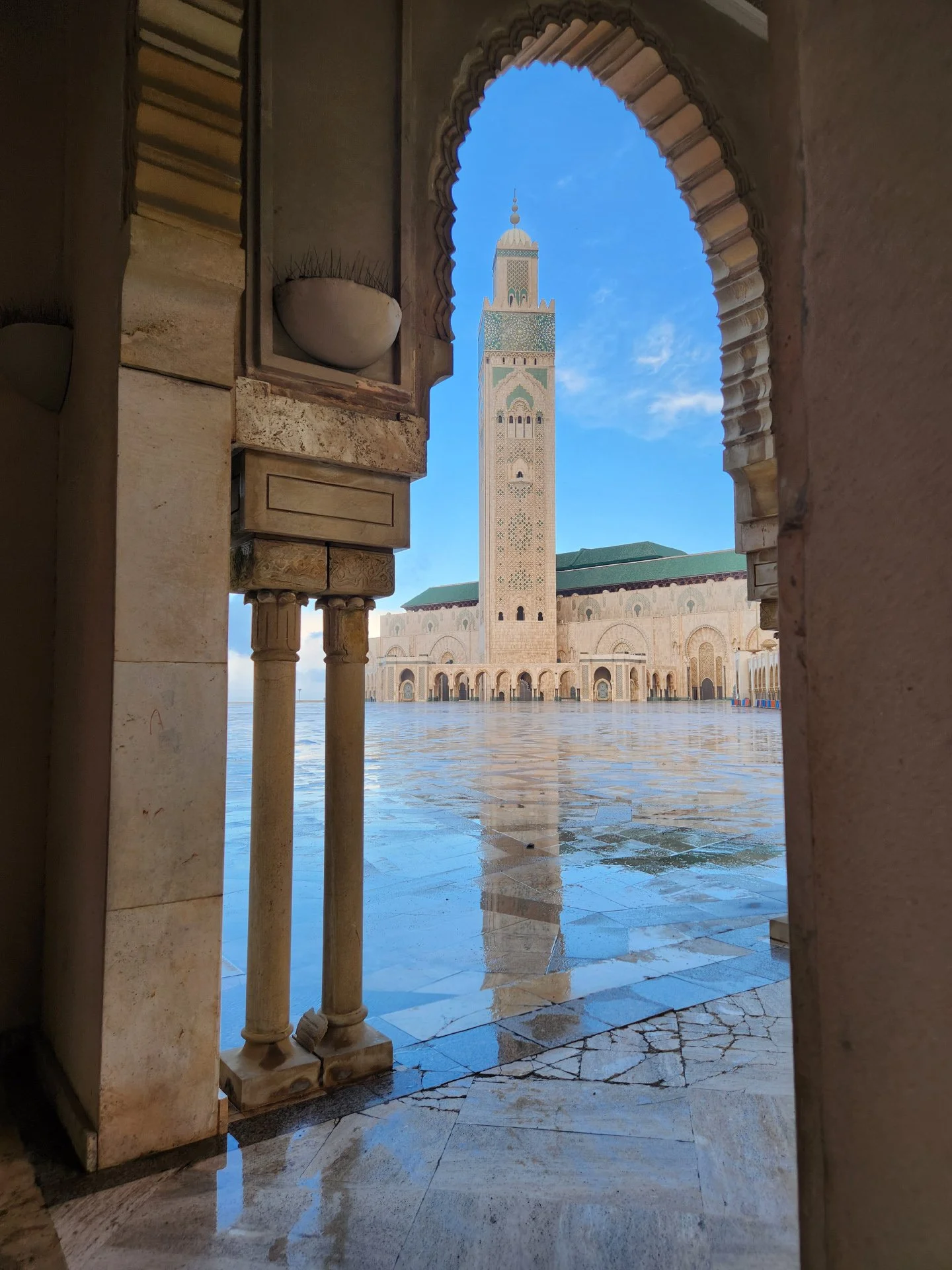
Hassan II Mosque, Casablanca
After the earthquake, the city was rebuilt yet again, this time by the reigning Sultan Sidi Mohammed Ben Abdellah. He called it “Dar El Beida” (Arabic for “white house”) but with the huge advent of trade with Europe, the name of Casablanca finally stuck starting in the 1780s, so I’m told. It was later solidified in the pantheon of place names by the 1942 romantic drama about a guy named Rick and his famous café. (The café, by the way, was a fiction built on a Hollywood set. In 2004, an enterprising American named Kathy Kriger, a former diplomat, built Rick’s Café near the Casablanca shoreline where people, tourists mostly, can enjoy some nostalgia and live music with their meals. Maybe the piano player will play it again, Sam.)
The Casablanca of the 21st century finds it less chock full of touristy stuff and more focused on being the financial capital of this very modern nation. It has become a powerhouse of international commerce, banking and trade.
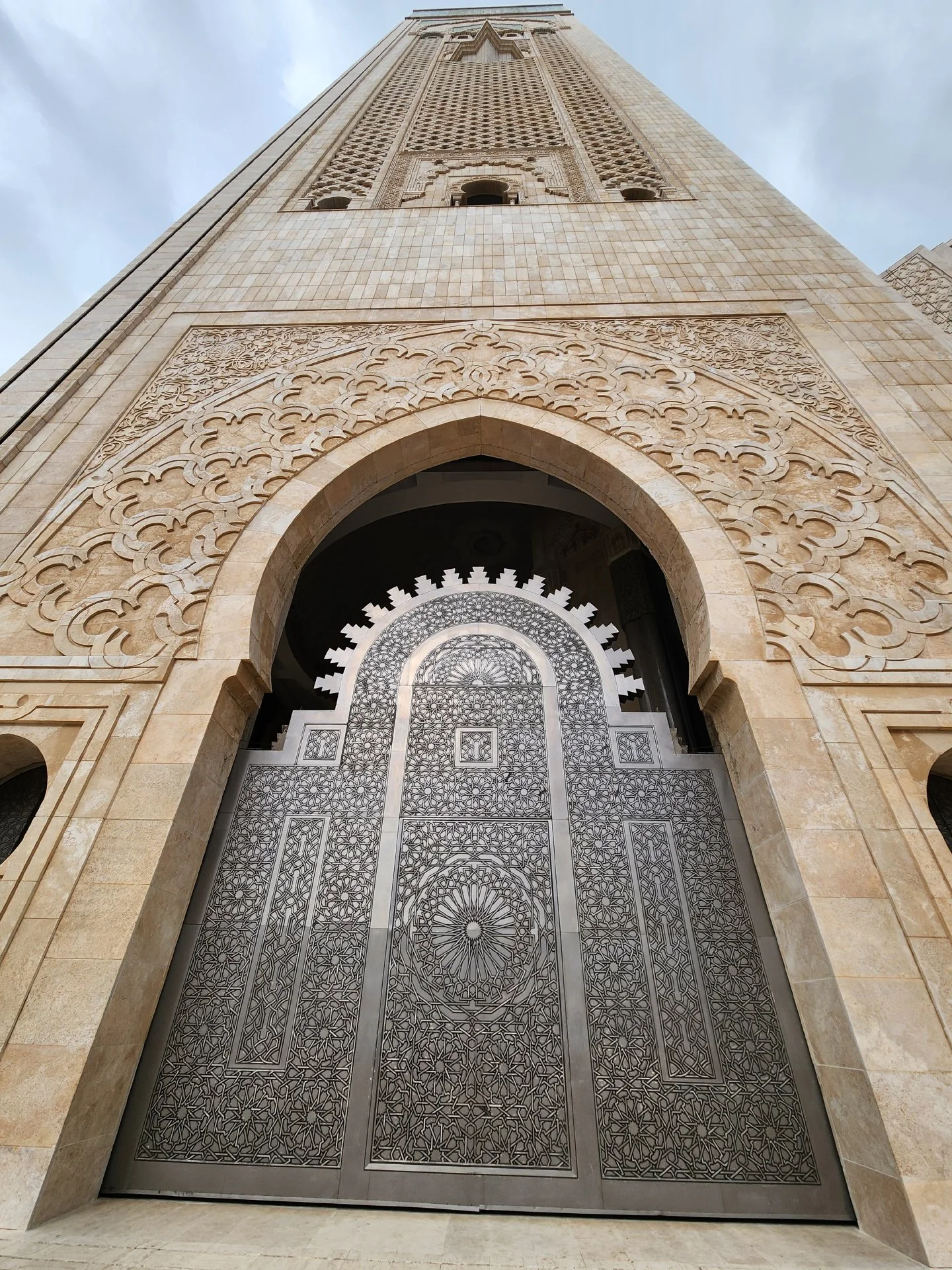
Looking up past the entry gate to the top of the minaret
On our day tour, our Booking.com guide, Hamid, centered our activities on two places: that white-housed hillside, and the mosque. As we drove through the area of (still mostly) white houses, we paused to see the former Anfa Hotel, site of the pivotal World War II “Casablanca Conference” in January 1943. The meeting was primarily between US President Franklin Roosevelt, UK Prime Minister Winston Churchill, and the sovereign (later, king) of Morocco, Sultan Muhammad V. (Soviet Secretary General Joseph Stalin was unable to attend because he was contending with the Battle of Stalingrad.) The outcome of this meeting was the Casablanca Declaration, a unified statement of purpose that said the Allies would accept nothing less than unconditional surrender by the Axis powers. (Given its historical importance, the former Anfa Hotel is now being renovated and will soon serve as a museum to commemorate those events.)
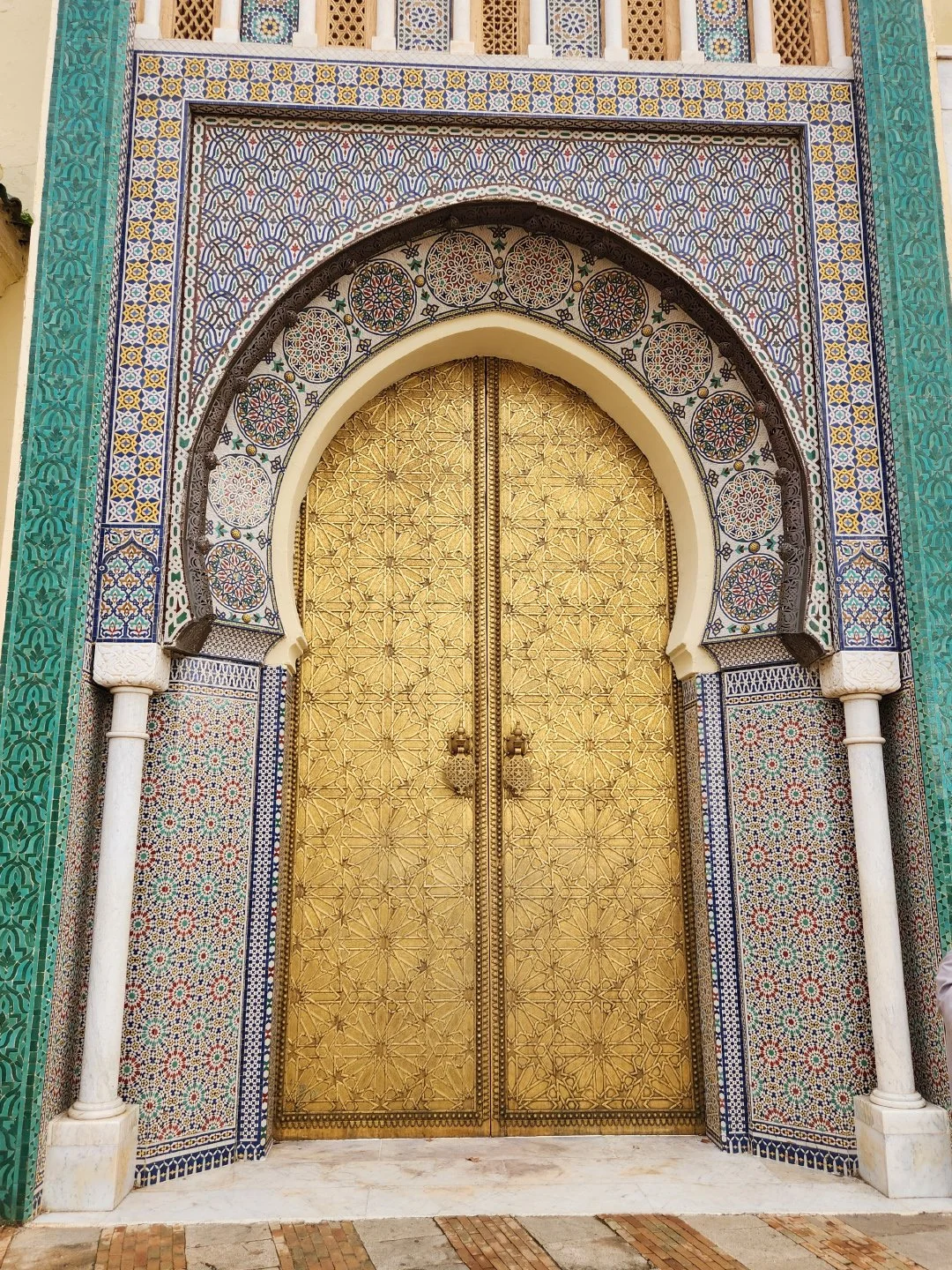
An example of the craft of zellige
The main hall holds 25,000 segregated worshipers (women on balconies upstairs)
Earlier in the day, we visited the Hassan II mosque. Our timing yielded perfect morning light after a day of rain as well as minimal numbers of fellow tourists, who tend to arrive in droves. It was a memorable experience. A recent addition to the Casablanca skyline, the mosque stands on a promontory overlooking the adjacent Atlantic Ocean. It was built in just six years from 1987 to 1993 by the son of Mohammed V, King Hassan II (1929-1999) who reigned over Morocco from 1961 until his death. He wanted to build the farther-west mosque in the African Arab world in order to incorporate the elements of not only land and air, but also water. Thus, part of the mosque’s foundation lies deeply embedded in the ocean water.
Changing a lightbulb is no small feat!
Among the largest mosques in the world, Hassan II mosque is deeply Moroccan. It was built and decorated by Moroccan builders and craftspeople using carved plaster, ornate tile designs (known as “zellige” which is different from mosaic), and carved cedar. The work was painstaking. For example, we were told that it took craftsmen four to five days to carve each square meter. Source materials were almost entirely Moroccan except the 56 chandeliers. The cost of construction—about US$700 million— was largely by public donation. Twelve million people stepped up to give. Each received a receipt and certificate, even the smallest donors of just 5 dirham (about fifty US cents).
The Ablution Rooms (underneath the main hall)
The minaret on Hassan II mosque is the world’s second tallest at 689 feet (210 meters). Luckily, the muezzin who call the faithful to prayer five times every day can take the elevator instead of the 1,200 steps to the top! Atop the minaret, a laser beam oriented towards Mecca lights up electronically in the evening and can be seen for miles. Inside, the ornate decor and almost relentless designs include walls of hand-crafted marble, chandeliers holding a total of 80,000 lightbulbs, 360 speakers embedded throughout within ornate plaster columns. The gold-gilt roof is retractable, which is surely a relief when a full house of 25,000 people gather to pray, especially in the hot months! They can be joined on the gigantic plaza outside by another 80,000 people.
The (giant!) main gate of metal rises to open
In addition to the mosque itself, the complex has other structures: a madrasa (Islamic school), hammams (bathhouses), a Moroccan history museum, conference halls. The library is said to be exceptionally comprehensive. In the courtyard are forty-one elaborately decorated fountains, and the beautiful gardens are popular for family picnics. In all, the place is enormous, and worth a visit. It is a true monument of achievement.
The plaza walking away from the mosque
While driving around Casablanca, we could often see the beautiful mosque from a distance. On a nearby ocean point, the historical fishing shanties have been demolished, sadly, to make way for upscale development (including one being planned by Ivanka Trump). When the FIFA World Cup starts in Morocco (co-hosts: Portugal and Spain) in 2030, the Casablanca scene will surely be much different than what we fortunately witnessed.