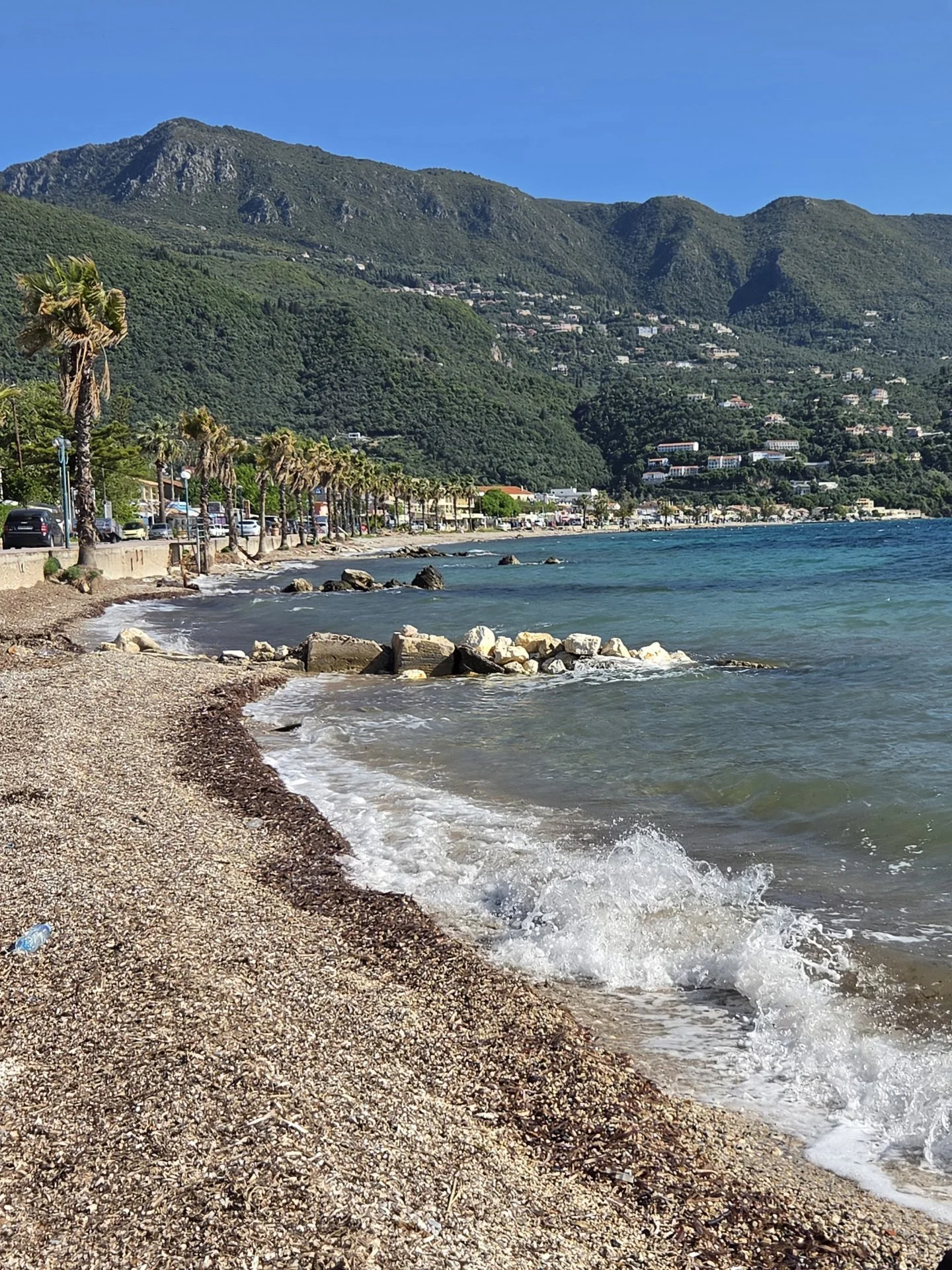
Corfu Days
What better way to recuperate from a rigorous 35-mile hike than a few days on a Greek island? We thought that sounded like a good plan, so on the heels of our Zagori adventure, my travel buddies and I rented a car and drove south from the city of Ioannina to the coast. It was a pleasant ninety minutes through wooded, mountainous terrain downhill to the seaside city of Igoumenitsa. There, we boarded the Kerkyra ferry to the famous island of Corfu.
Why Corfu? Well, we knew the name because it’s famous. Mostly, though, we landed on Corfu simply because when we looked at the map of Greece, it was the handiest island to reach from our earlier plans — expediency at its finest.
Which of these images do you prefer? The “real” one or the watercolor version, created by options on my camera?
Many know of Corfu thanks to the wonderful writings of naturalist Gerald Durrell. His “Corfu Trilogy” (recommended by my brother) is a great read! I got a head start on loving Corfu with the first book, “My Family and Other Animals” (1956). It tells of Durrell’s early childhood on Corfu with his chaotic but humorous family. A celebrated TV adaptation of the book, “The Durrells in Corfu,” was filmed in 2018.
Ours being a self-guided journey, we found our Air B&B and the nearby grocery store after only one slight motoring mishap, and settled in, wine glasses in hand. The next morning, day one of our two full days on Corfu, we set out to circumnavigate the island. Forty miles long and 20 miles wide, the island boasts generally two lane roads, winding and narrow. The inland terrain of Corfu is punctuated by two mountain ranges whose highest points reach 2,972 feet and 2,785 feet respectively. It’s a rugged, diverse place. Speaking as the driver, I can attest to how exciting the roads were, with lots of elevation and twisty turns and, sometimes, large tour buses coming the other way!
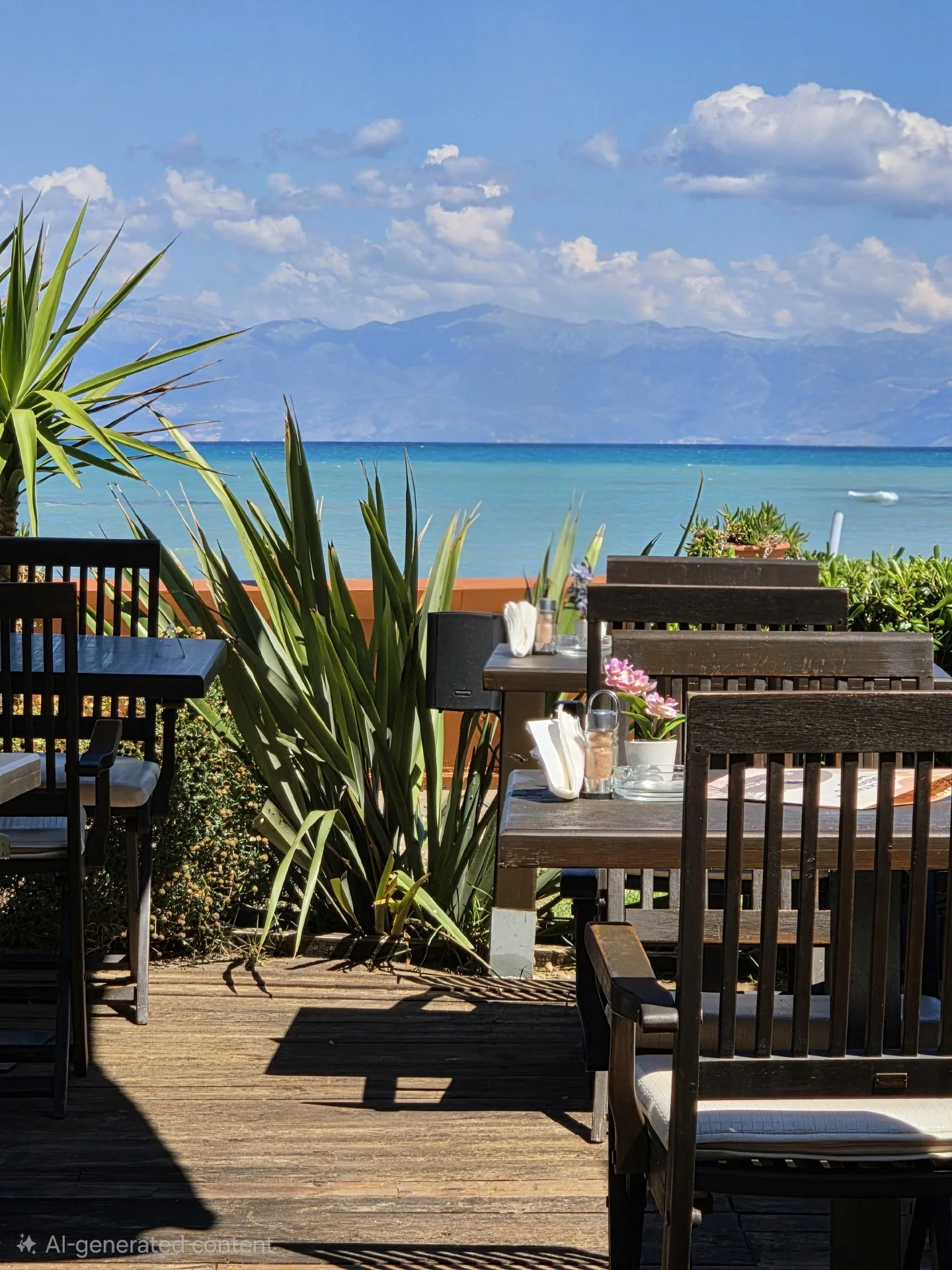
The view across to Albania from our lunch table
Sitting as it does at the junction of the Ionian and Adriatic Seas in the north, Corfu looks across to Greece’s neighbor, Albania. The strait between Corfu and that beautiful, rugged coast ranges from two to 14 miles. We stopped often to admire the view, see the sights, and, on the north coast, enjoy a beachside lunch in the town of Sidari. Our timing was ahead of the summer hordes of tourists who would before long line the many bays and beaches.
Greek for “Issos” (and other instructions!)
In the afternoon, we drove along the west side of Corfu. Along one stretch in the highlands dominated by olive trees, we stumbled across the Mavroudis Olive Oil Estate. There, a handsome young man, the latest in many generations of his family, gave us a splendid, spontaneous tour and olive oil tasting. Afterwards, we followed more of the island’s 135 miles of coastline south almost all the way to the tip. Corfu is famous for its beaches, and many are located along the west coast. We stopped at Issos Beach for a walk and ambled for some wonderful miles, our happy feet in the sand. The appeal of the Greek islands was completely evident.
Morning light on Neo Frourio (the “new citadel”)
The access ramp to Neo Frourio
Our second day was devoted to the island’s cultural and historical sites in and near Old Town. A UNESCO World Heritage site, the old city bustles with tourism. Narrow, winding streets are too small for vehicular traffic, and we were smart to arrive in the cool of morning. Because we happened to park next to it, we climbed up to Neo Frourio (the “new citadel”), a looming huge stone fortress. Built atop older Venetian ruins by the British during their occupation (1813-1863), it lent wonderful views to the east across the city and another major site, Palaio Frourio (the “old citadel”). Then we enjoyed walking and browsing shops as they opened for the day while we made our way through the city. We paused to see the famous Spianada Square and then went into Palaio Frourio.
The view from Neo Frourio across the Old City to the Venetian citadel
The Venetian fortress is perched on an eastern overlook of the straits. These fortifications date back to Byzantine times (6th century) but were amplified and fortified by the Venetians when they arrived in 1386 to occupy Corfu. They stayed for more than 400 years, which led to significant Italian influences on every aspect of life in Corfu. (The British took over in 1815 after the Napoleonic Wars until Britain ceded it to modern Greece in 1864.)
Access route into the New Citadel!
Our exploration of the Venetian citadel was hampered by a high white fence separating tourists from...what? We could see a beehive of activity and hear people being guided by a bullhorn to stand in straight lines. Then we saw an American flag flying. What?? Finally, we learned that it was a movie production. Watch for the release of a film starring Daniel Craig in coming months!
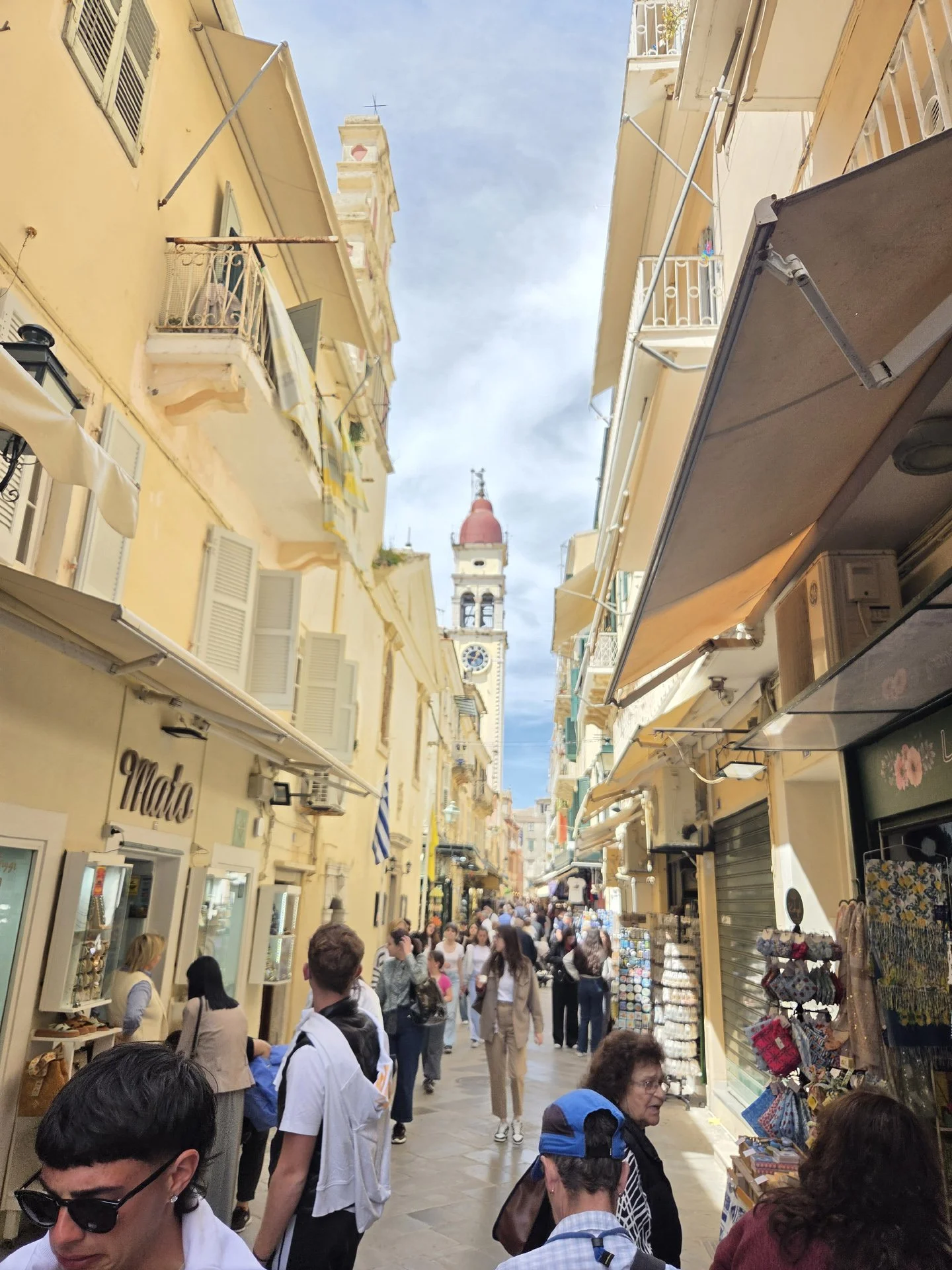
Old City street...before it got crowded!
A small part of Palaio Frourio where the movie wasn’t being filmed
By afternoon, with the heat of the day and the suffocating hordes in the streets searching for the just-right souvenir, we ate some gelato and then evacuated back to our quiet, peaceful lodging. There, we enjoyed the evening celebrating a great trip before heading home the next day.
Early morning view departing Corfu: Palaio Frourio and the Old City