Loving Slovenia
Slovenia: what a pleasant surprise! More than a decade ago, a writing professor waxed eloquent about Slovenia as being one of those special, quiet places in the world. It has been in my sights ever since, and the chance to go there finally came in August 2026.
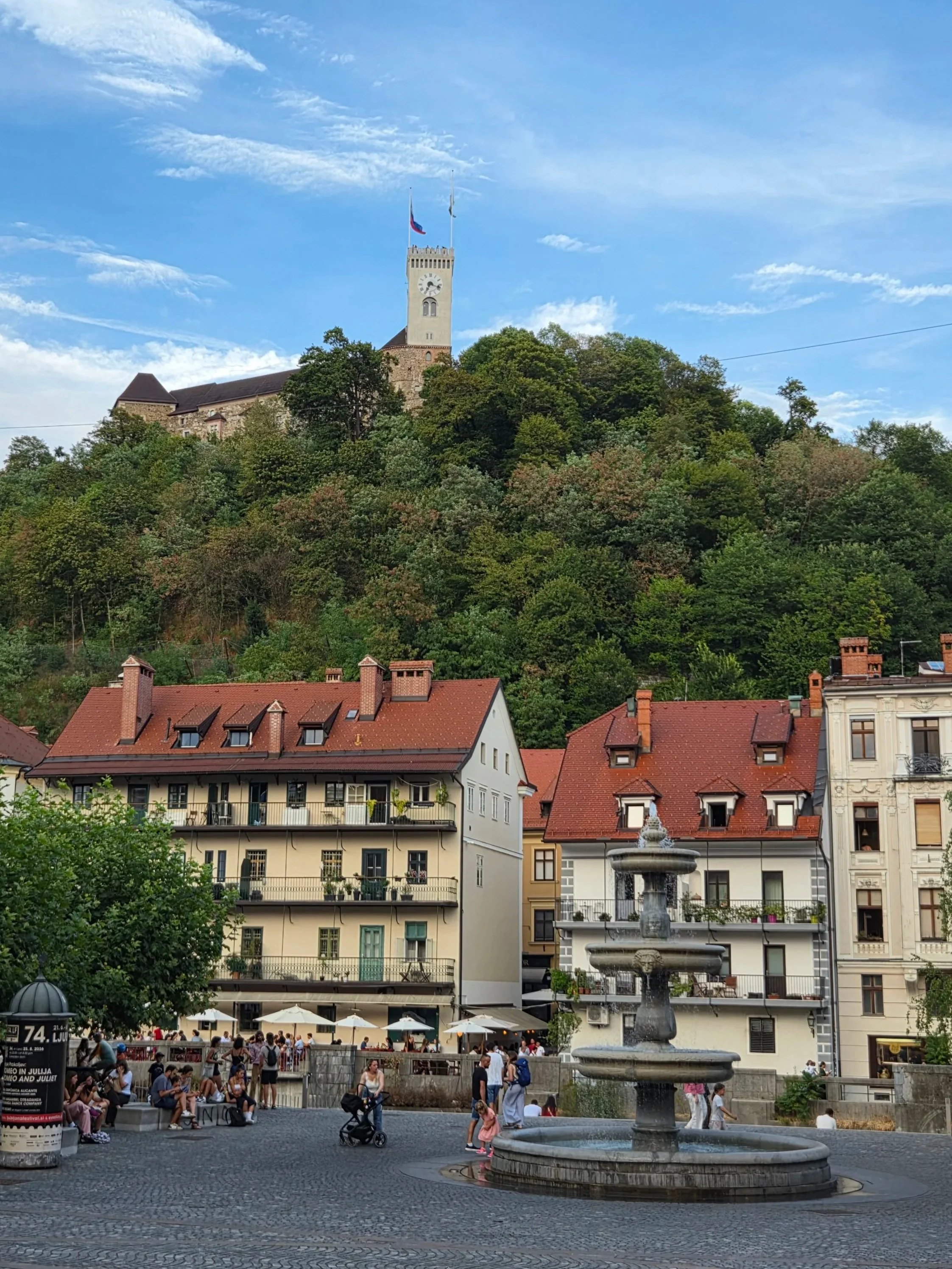
Looking up at Ljubljana Castle from the center
Slovenia has (so far) dodged the over-abundant onslaught of tourists. But where is Slovenia? This was the most frequent question when I told people of my next adventure. Officially known as the Republic of Slovenia, this well-developed country shares borders with Italy, Austria, Hungary and Croatia. It is mostly mountainous and densely forested, although there is a smidgeon of coastline just south of Trieste, Italy. For an area about the size of Massachusetts, Slovenia offers a great variety of terrain and a lot more, including a robust wine region.
Slovenia is, by the way, the only nation with the word “love” in its name...and it is easy to love. I traveled with a long-time friend, Linda, and her daughter and son-in-law. Linda was on her fourth trip to Slovenia—making her our handy built-in guide! We met up in the capital city of Ljubljana, whose population of 303,000 makes it Slovania’s biggest city. (The country’s total population is 2.1 million, compared with the 7.2 million people living in Massachusetts.) In the context of world capitals, Ljubljana is delightfully relaxed and unprepossessing.
Town Hall, Ljubljana
Triple Bridge
Dragons are Ljubljana’s symbol, as depicted in the city’s coat of arms, on a castle tower on the hill above the city, and on Dragon Bridge, which was completed in 1900. What’s not to love about dragons, which are said to represent power, courage and greatness. Are they the stuff of mythology? Folklore? Who knows, but the dragons in Ljubljana were really fun to see.
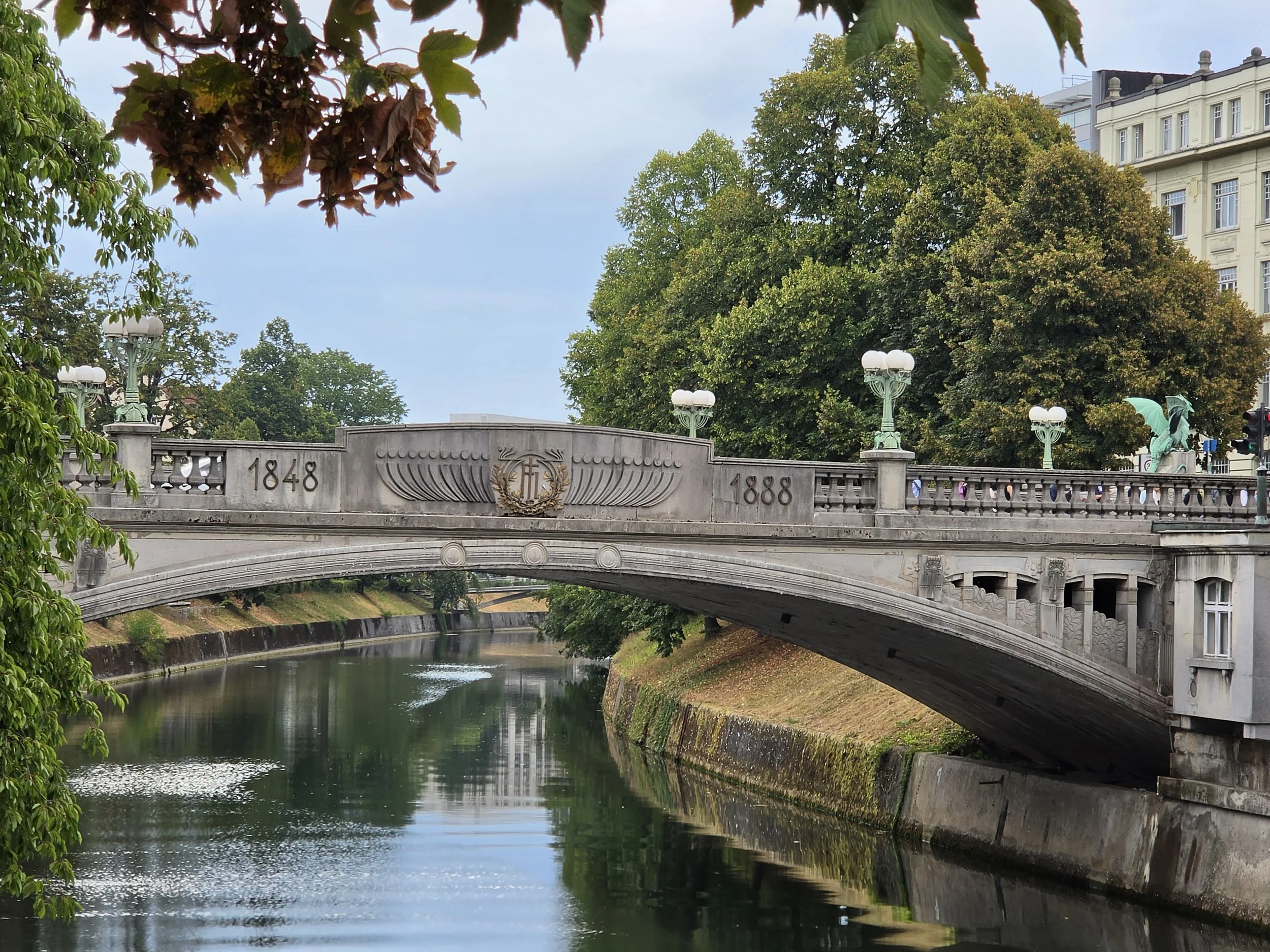
Dragon Bridge
The winding course of the Ljubljanica River through the heart of the city at the base of the castle hill yielded wonderful spots to nurse a refreshing Aperol spritz or beer while people watching. In addition to Dragon Bridge, other cool bridges included Butcher’s Bridge (with its mythological bronze sculptures), the Triple Bridge with two pedestrian bridges alongside the vehicle crossing (all made of white stone), and the see-through glass Fish Footbridge, completed in 2014. As in many European cities, there were many fun side streets to wander, often leading to beautiful public squares.
A whimsical sculpture on Butcher’s Bridge
We spent two full days looking around the center of Ljubljana. We bypassed the funicular option and hiked up the small hill to the medieval Ljubljana Castle, built in the 12th century. We could have spent all day there, seeing (and hearing about, on our audio-tour devices) all manner of castle life and history. Back on the flat, the extensive public market was filled with lovely, colorful August abundance. The gelato? Fabulous.
The central courtyard of the castle
Ljubljana has certainly seen its share of troubles. In modern times alone, a 6.1 magnitude earthquake in 1895 leveled much of the city, then with a population of 31,000. Then on the heels of rebuilding and reviving the city from the earthquake—work completed in 1910—residents faced the horrors of World War I. In 1941, Slovenia was occupied by Italy, followed by the forces of Nazi Germany, who surrounded Ljubljana with barbed wire. After the war came reprisals, and too many mass graves.
View of Ljubljana from the Castle Tower
Politically, Slovenia’s history is, well, complicated. Over time, the territory has been part of many states, including the “...Roman Empire, the Western Roman Empire, the Carolingian Empire, the Holy Roman Empire, the Kingdom of Hungary, the Republic of Venice, the Habsburg Empire, Napoleonic France, the Austrian Empire and the Austro-Hungarian Empire.”
A cool double-spiral staircase in the tower!
In the latter decades of the 20th century, it was one of the six constituent nations that composed Yugoslavia. Slovenia battled its way to independence from Yugoslavia (including bloody, lethal conflicts) in June 1991. In May 1992, it became a member of the United Nations. It joined NATO in March, 2004 and two months later, Slovenia was officially admitted to the European Union.
In 2026, I discovered Slovenia to be a model nation for those interested in peace and caring for the welfare of the planet. Recycling, including composting organic waste, is a national point of pride,. I believed it when I was told it is now considered one of the greenest nations anywhere. The roads were excellent, driving was easy. Navigating a place where the Slavic languages dominate can be daunting (all those consonants!), but signs tended to be bilingual for visitors. People were friendly and helpful.
And if you love hot chocolate? Slovenia is the place for you. I had to spoon mine, it was so thick and delicious. Stay tuned for more about Slovenia!