Morocco VI: The Road to Skoura
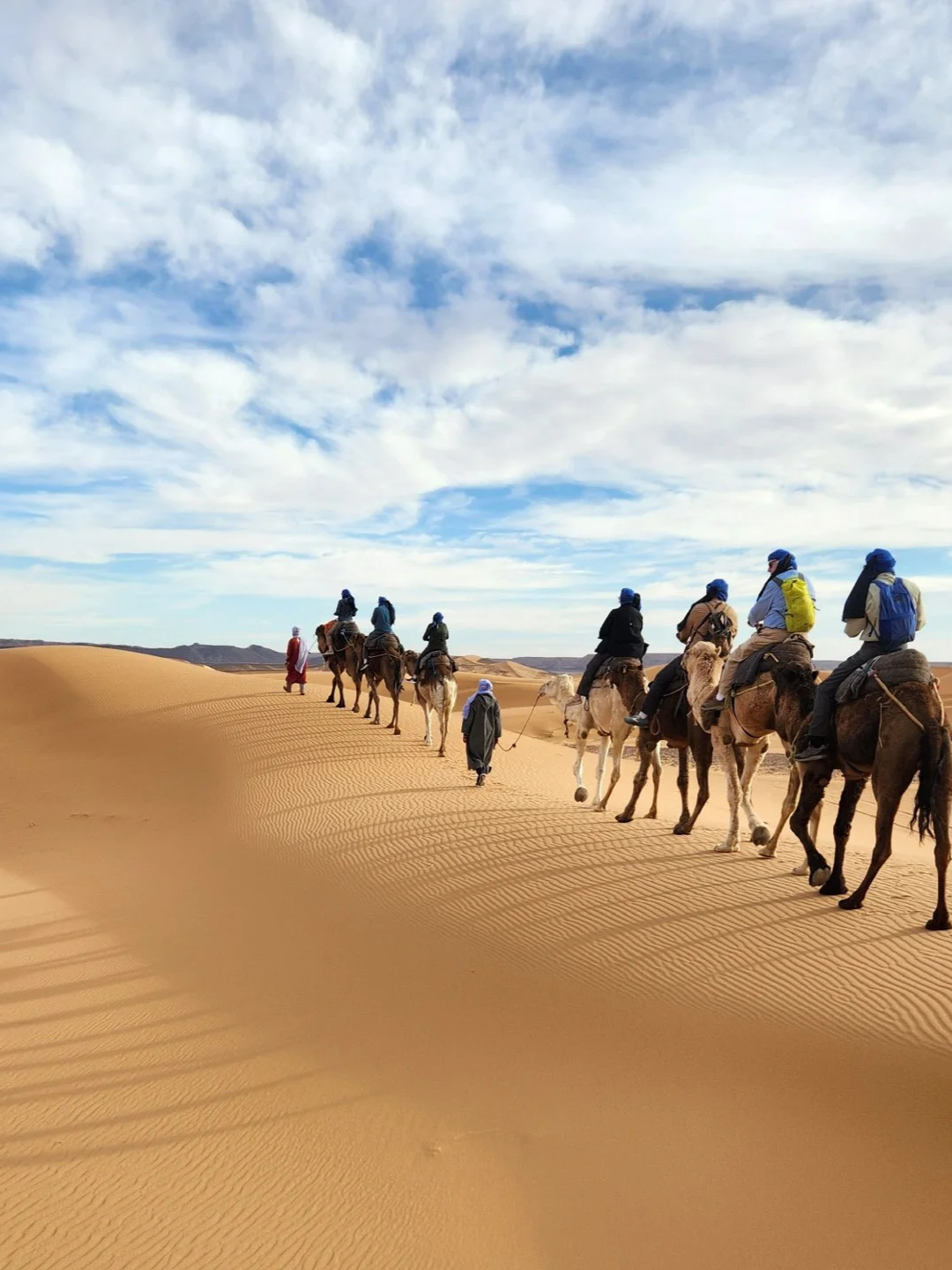
After two splendid days in the desert, our journey around Morocco resumed. At Erfoud, where I had earlier very nearly purchased a beautiful fossil-laden coffee table, the merchant offered new bargaining terms, but it was not meant to be. Instead, our merry band of travelers forged ahead to new adventures along the southeastern flanks of the Atlas Mountains.
Parallel excavation piles of two Khettara canals marching across the plain
Underground canal. The swerving was intended to slow the water down.
On a desolate stretch of road during our drive to Skoura that day, there were suddenly mysterious rows of dirt piles in a straight line leading to the far-off mountains. We had arrived at the Khettara canals, a Moroccan drylands water management system typically built by slaves that thrived in the 14th century. Those we visited were “new” (built in the 17th century). What an amazing feat of engineering: underground canals (to minimize evaporation) dug using a series of vertical shafts about every thirty feet for ventilation and excavation. (The dirt piles were the excavated material.) Reportedly, there were once about 185 miles of canals—and not one pump. A slight, consistent gradient of only 1-2 degrees moved snowmelt and groundwater hundreds of miles from higher ground to the arid regions, transforming barren areas into lush opportunities. Most are no longer in use due to falling water tables (and electric pumps). It was eerie, though, to enter a disused canal and walk along what once would have been several feet of water coursing to a far-off fig tree somewhere.
Lunchtime around the family dining table. Top Right: Flag with the Berber symbol for “freedom.”
The khattara system enabled places like the Tafilalt oasis, a vast region with 116 villages. By tradition, the bottomland is communally owned for growing the 100 species of palm trees and other crops. Later that day, we hiked down from one such village and walked the length of the green valley floor. There, the springtime crops were bursting forth, tended by sophisticated irrigation systems using historical methods for sharing the water locally.
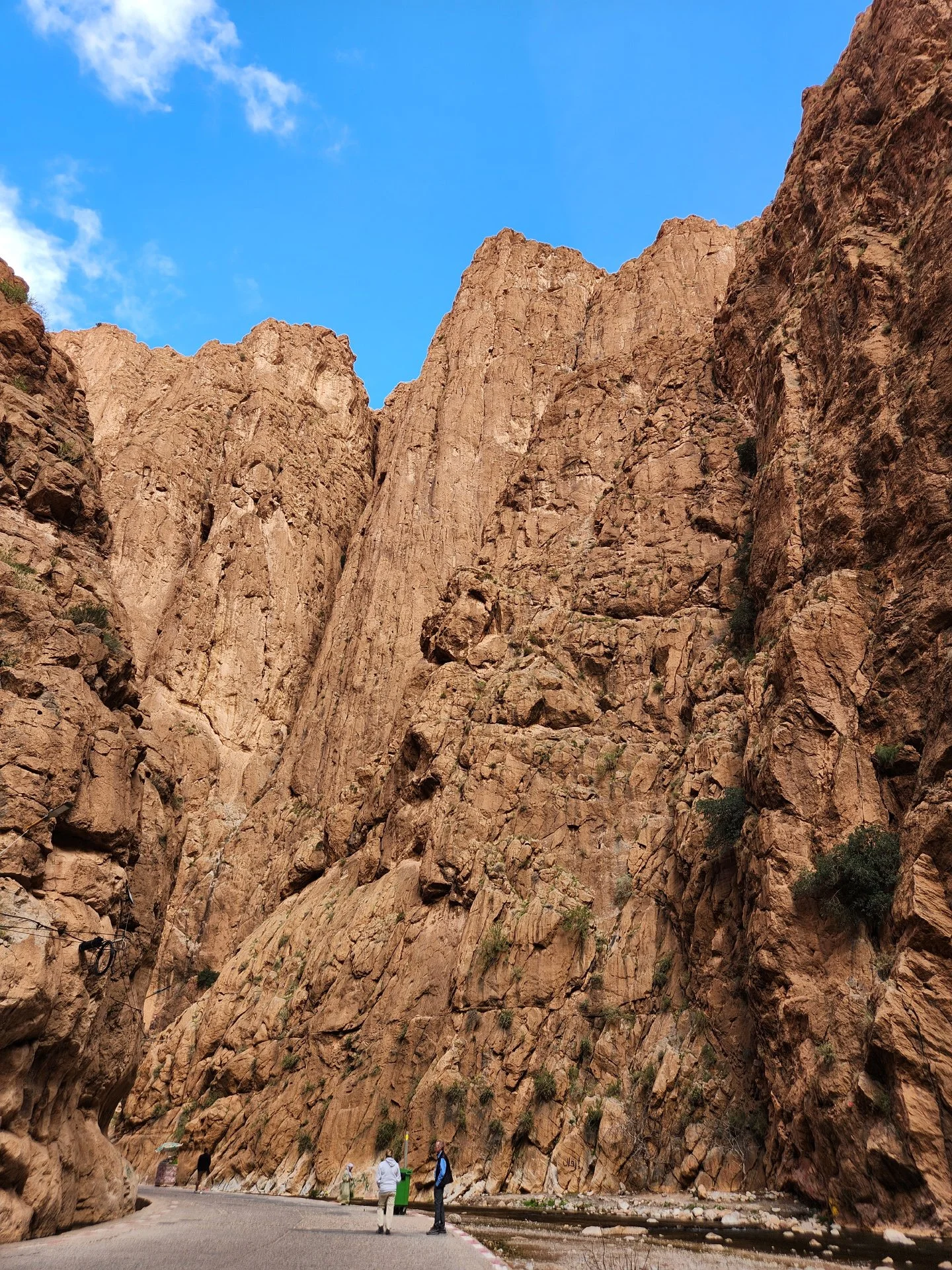
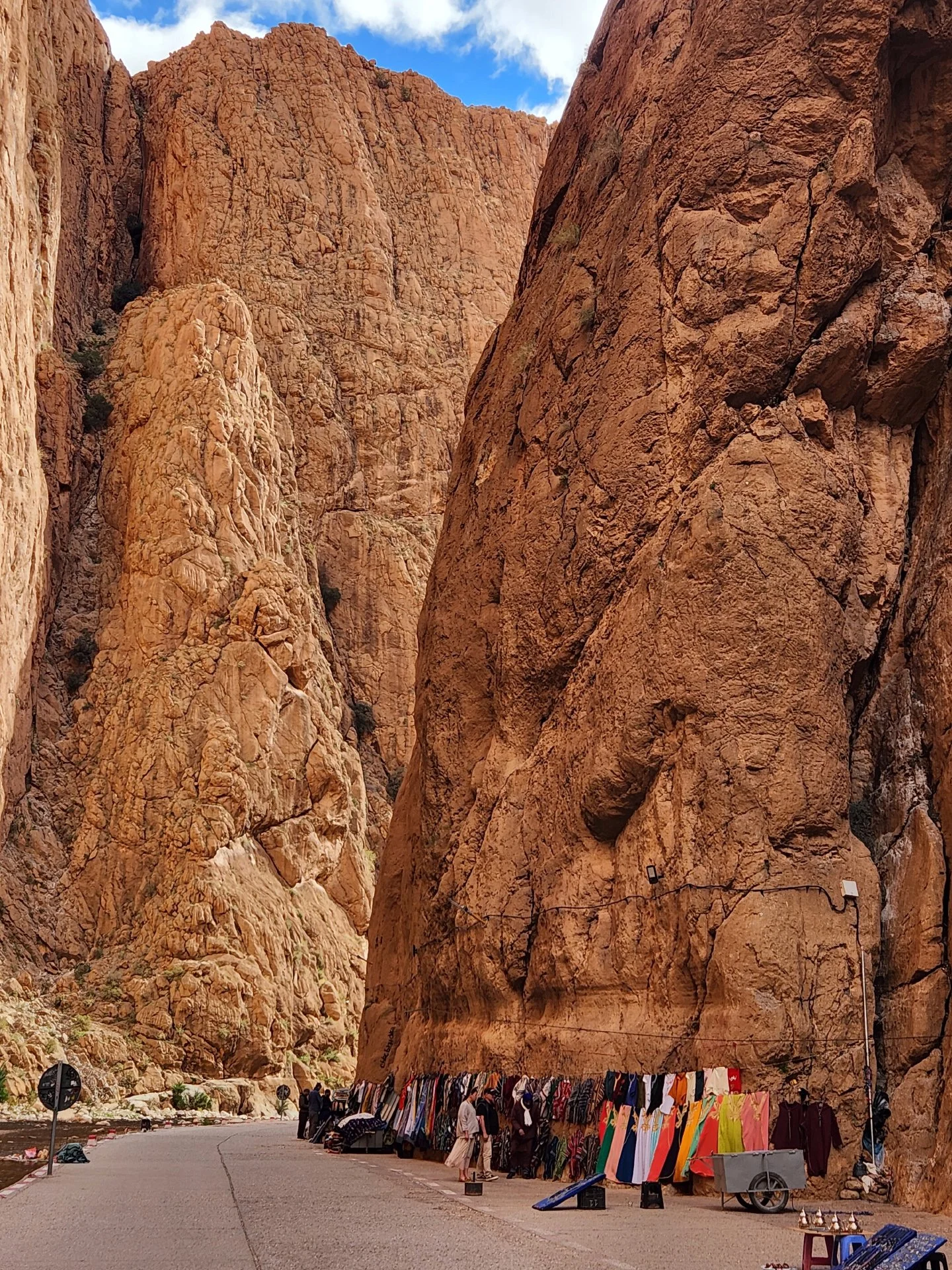
Todhra Gorge
But first! A well-fed tourist is a happy tourist, and at lunchtime all eleven of us crowded into the dining room of a local Berber family for a delicious home-cooked meal. Waves of food arrived: salads, different tagine dishes, breads, and fruit for dessert. Tagine, the national culinary dish, is slow-cooked in a conical earthenware dish layered with vegetables and meat sprinkled with tagine spices, and topped with preserved lemon. It was at lunch that I tuned into a beautiful flag on the wall with the Berber symbol for “freedom.” (Ali says it is also the Berber alphabet’s equivalent of our letter “z”.)
The Atlas Mountains offered a new surprise to us after lunch. We came around a corner and suddenly we were squeezed between the sheer 1,000-1,300 foot cliffs of the Todhra Gorge. The area is widely popular with rock climbers and hikers. We lingered briefly on the valley floor while mostly looking up and wandering past the many hopeful souvenir merchants. I departed with the thought that I may have to go back there someday...
The imposing entrance to our ksar accommodations.
Turning reluctantly from the heights, we headed for our two nights in the modern oasis town of Skoura. Its roots stem from the 12th century and are primarily influenced by traditional Berber culture. In this quiet place are millions of trees that grow the figs, dates, olives, and almonds so prevalent in Moroccan cuisine.
Interior courtyard from the upper landing
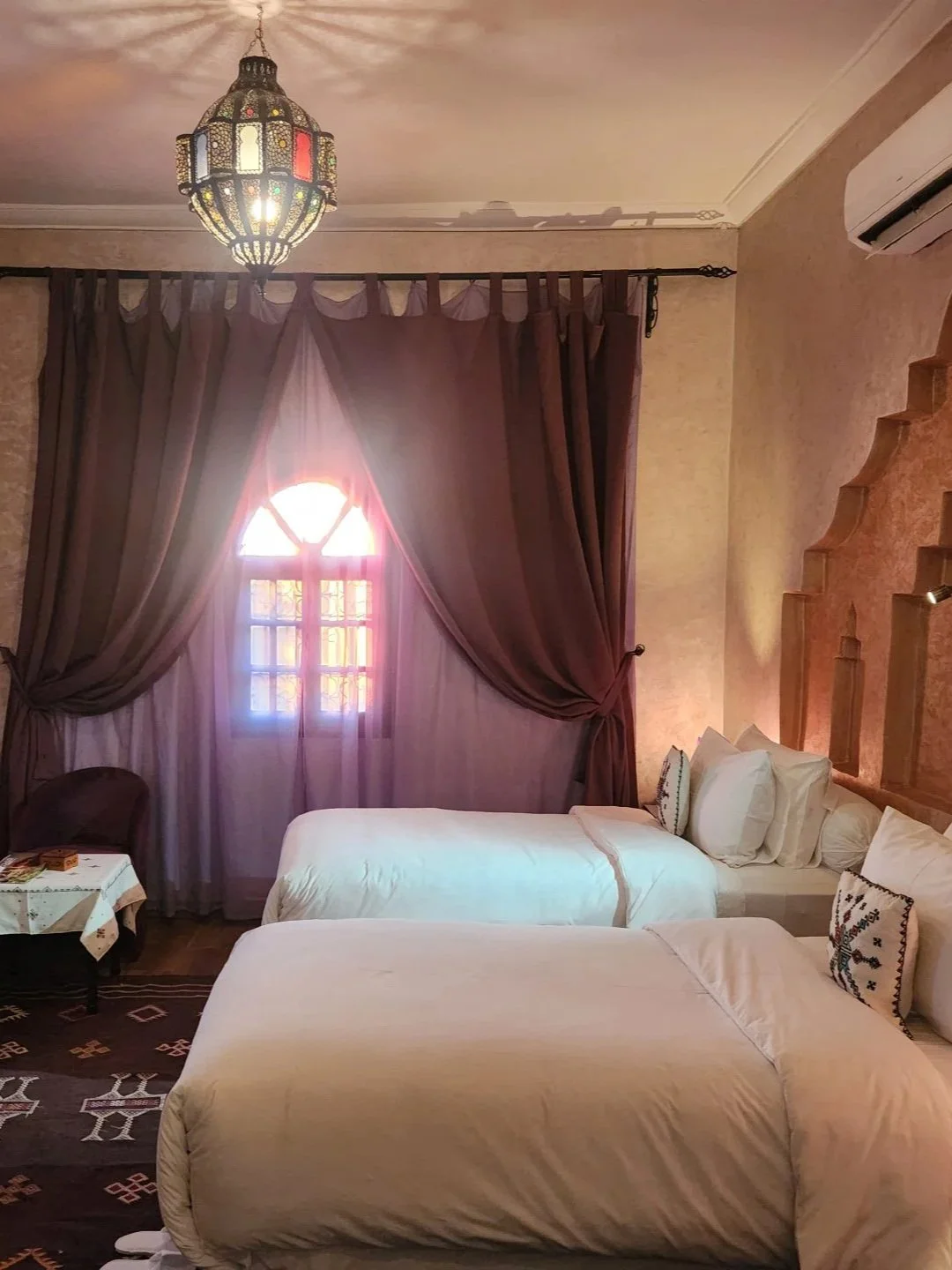
Our quarters for the next two nights were in a beautiful renovated ksar (fortified home). Reminiscent of olden times, the Ksar el Kabbaba had imposing front gates and high mud-brick walls. Inside, an open central courtyard revealed exquisite accommodations, and the gracious, capable, attentive care we found there was truly memorable.
[Our trip guide was the incomparable Ali ait Ichou. Our adventure travel company was Wilderness Travel. For more about it, see https://www.wildernesstravel.com]