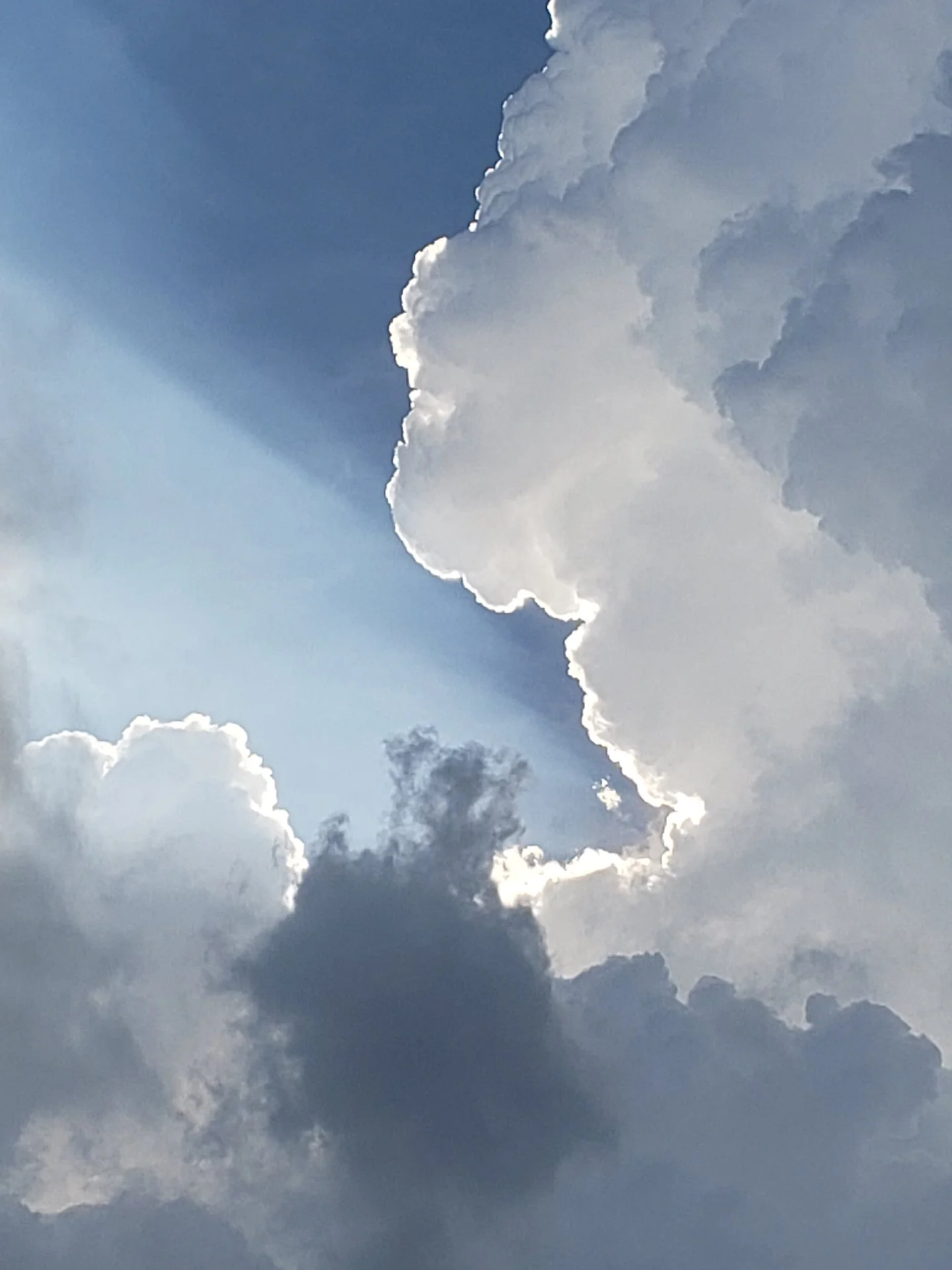
Look To The Sky
With the sky as my ceiling, I am happiest, because it means I am outdoors, immersed in the day. The air is fresh. I can hear the birdsong and frogs, feel the breeze, smell the earth. When the clouds are backdropped by blue—that’s my favorite. But honestly, even rainy days with their hovering drippy clouds are fine, too.
The sky! Whatever it offers when I raise my eyes to it, I feel gratitude for the chance to be present. The sky joins me to loved ones far away, even across oceans. It is a cap we share. It connects us all. Clouds are the curtains to the sky. They present themselves in many shapes, sizes, and colors. How is it possible not to love clouds?
I started collecting photos of clouds before I learned about Alfred Stieglitz’s body of work on the same topic. Stieglitz was 58 years old when he started photographing clouds in 1922, the same age I was when I “discovered” him. The resulting project, titled “Equivalents,” was embodied by several hundred photographs. His images mostly show ethereal vapors in the sky, wispy and patterned. He felt that such abstract forms, lines, and colors could be the equivalence of corresponding inner states, emotions and ideas. This approach disrupted the late 19th/early 20th century status quo view of art, which until then was mostly straightforward and realistic.
Thus, Equivalents was rather controversial. In 1923, Stieglitz wrote in “How I Came to Photograph Clouds” that, “I wanted to photograph clouds to find out what I had learned in 40 years about photography. Through clouds to put down my philosophy of life—to show that my photographs were not due to subject matter—not to special trees, or faces, or interiors... [C]louds were there for everyone—no tax as yet on them—free.” This juicy twist in the design of an image rejects the notion that a photograph is only good for depicting reality. Thus, Stieglitz creates the concept of “photograph as metaphor.” It is a tool for contemplation that transcends the image itself.
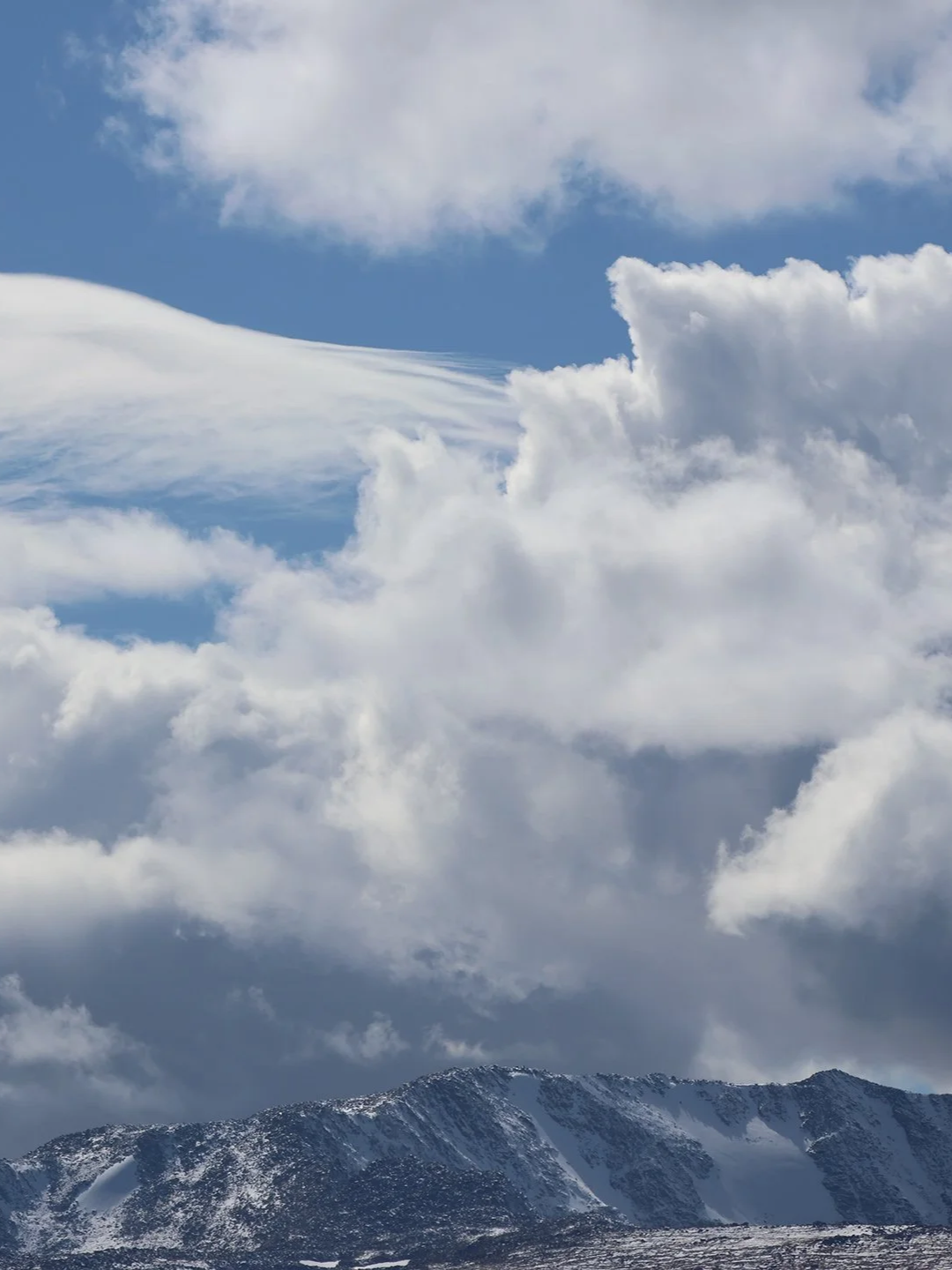
In an attempt to explain this, Minor White (himself a renowned photographer) wrote in 1963 that people see what they will in an image, but not necessarily what the photographer believes is being shown. “Our usual tendency, if we make the attempt to engage, rather than reject, the ambiguous rendering of a subject in a photograph, is to invent a subject for it,” he wrote. “...If the viewer engages the images at all, then the viewer will see something of himself. If what he sees is unpleasant,...there may be some truth in that some part of himself is unpleasant... If he is struck with terror, perhaps he has met something worthy of his fear. If he finds something magnificent, it is because something beautiful in him has been magnified.”
The implicit design of clouds is constantly in flux, as is life. I admire the vastness of clouds, and the eternity they curtain. I cannot help but record them. Clouds magnify me.
[This blog has been updated and edited from when it first appeared in the blog “Design Destinations” in April 2012.]